

De Kocks and Singapore champion Brown return to Premier looking for next stable stars
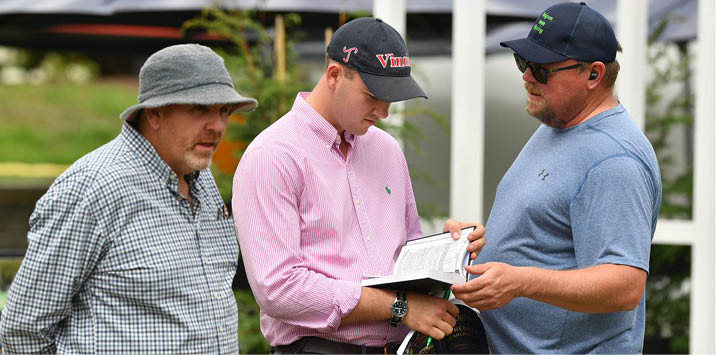
Fillies make appeal for internationally recognised horsemen at Inglis’ Victorian auction
Champion trainer Mike de Kock has returned to Australia for the first time in two years, a dual-purpose trip for the South African, while the Inglis Premier Yearling Sale also coincides with former top Singapore trainer Cliff Brown’s debut as a Mornington handler.
The pair – De Kock with his son Mathew, the younger half of the Griffiths-De Kock training partnership at Cranbourne, and Brown with his son Harvey – were at the Oaklands Junction sales complex yesterday inspecting horses.
De Kock and his wife Di arrived in Melbourne earlier this month to visit their son Mathew and his partner Monique Mansour, who gave birth to their first child, Liam, last week, and the father and son were whittling down their shortlists ahead of Sunday’s 2022 Premier sale.
De Kock Snr will be looking for his South African clients, having not been at an Australian sale since the 2020 Premier offering, and if he does successfully sign for a yearling they are likely to remain in Victoria to be trained by his son and training partner Robbie Griffiths.
“It is very costly to ship horses back to South Africa – that’s almost become prohibitive – so we will be looking to leave a few here,” de Kock Snr revealed yesterday.
“We understand that this is one of the countries where you can get a real return on your investment. Owning horses is a hobby for most people, but Australia gives you a chance at the races.
“There’s also the second trade market for horses (to Asia) and you’ve got fantastic prize-money. One or two of my clients might buy a really well-bred filly and take her home, that’s possible, but right now we’re looking to leave them here.”
De Kock Jnr is also excited about the prospects of the Cranbourne stable, which is still in its infancy.
“The partnership is only just over a year old and it’s only getting stronger and stronger. After the Gold Coast sales, the horses were easy to sell, which shows that you are doing something right, and gives us confidence to come to this sale and back it up again,” Mathew de Kock said.
“It is a three– to five-year process to get all the new stock in and our first crop of yearlings we bought last year are only just starting to run.
“We bought a very balanced group in that they are going to keep getting better and a lot of them are going to be three-year-olds, not Slipper winners.
“Since I have joined the yard, we’ve bought some Classic horses, so it is another string to our bow, let’s say, and it gives us strength in all aspects of racing.
“If your two-year-olds don’t kick a goal, then you’re struggling, but at least we have horses who look like Derby and Oaks horses etc.”
One project put on the backburner by the de Kocks due to Covid, which they hope to soon revisit, is buying yearling fillies in South Africa and bringing them to Australia to race.
“The Australian breeders are slowly starting to realise that there’s a bit of value in the South African broodmares. They’re tough and a lot of the good ones have got Aussie female lines, so they are ‘go’ for Australian breeders,” de Kock Snr said.
“Mathew and I were looking at a bit of a game plan before Covid and that was to actually buy fillies there (in South Africa) because of the value.
“They’re not going to win you the Slipper, but a nice Classic–type pedigree which is going to take six to eight months to get to Australia.”
You can do all the pre-training (in South Africa) and then get them out to Australia, then you’ve got a horse for ten per cent of what you buy them for here.”
Another trainer with an international perspective is Mornington-based Brown, who returned after a successful 12 years in Singapore last March, and relaunched his career a few months later.
The Premier sale presents another opportunity in the rebuilding of Brown’s stable and the trainer is looking to boost the calibre of his team through the possible acquisition of fillies, which for at least the past decade have essentially been off-limits given the requirements of his Asian clients racing in Singapore.
“(Victorian racing) is so competitive, which we knew before we came back,” he said.
“I was talking to Michael Freedman after I’d been going a little while (back in Australia) and I asked him, ‘how long did it take to get going?’ and he said, ‘18 months to two years’ after he came back from Singapore and we’re in the same sort of boat.
“We’re getting there, but 60 to 70 per cent of the horses are two-year-olds, so they just take time.”
The allure of buying a Vobis-eligible yearling is also something new for Brown.
“It is a great incentive that we never even bothered with in the past. It didn’t matter whether they were Vobis or BOBS, because they were going to Singapore and they weren’t relevant,” he said.
“I assess the pedigrees first and then have a look around and see what fits both models: physique and pedigree and then try and buy them from there.”
Brown, a self-depreciating Aussie with a dry sense of humour, admits to making mistakes during his initial six months training from Mornington but believes he is continually adapting and the results are showing.
“I’ve had to change the way I feed, the way I work them and I am sure in six months’ time I will have made more changes. It’s just the realisation that you’ve just got to keep checking everything that you’re doing,” the trainer said.
“I think it was more something that I was doing in Singapore that just doesn’t work here. You get into routines and you think, ‘that’ll be great, I’ll bring that back’ and then you realise that it just doesn’t quite work here.
“The other thing is, the horses from Singapore have all needed that first prep to settle in and I guess they are no different to a lot of the European horses, they’ve all needed a prep to get going.”