

Balding ousted in late night back down
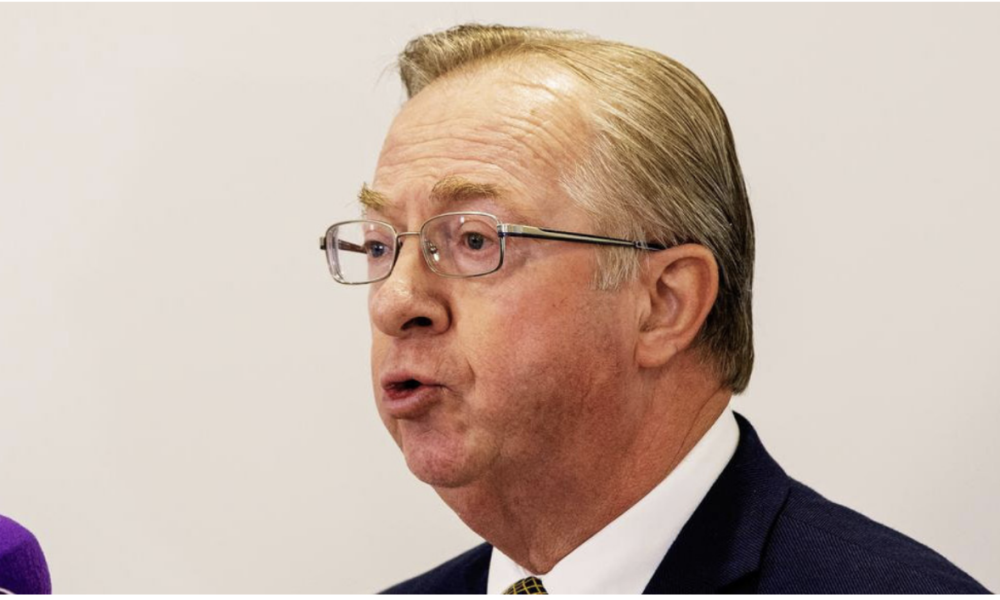
RNSW chairman to depart after government abandons board extension legislation
The head of Thoroughbred Breeders NSW hopes the defeat of Racing NSW’s push to again extend its chairman’s tenure can be a catalyst for change in Australian racing and breeding, promoting proper administration and striking a blow towards ending the state wars.
Hamish Esplin said the abandonment in state parliament of a bid to allow a third extension for Racing NSW chairman Russell Balding was a welcome development in the “very important issue” of corporate governance.
And he’s hopeful it can foment a new era of administration bringing cooperation between NSW and Victoria, to help fix the inability of Racing Australia to “do what it is obligated to do” and make essential changes “for the betterment of the game at a national level”.
In sensational developments on Thursday night and the early hours of Friday before parliament rose for the year, the Labor government withdrew its own bill to change the Thoroughbred Racing Act to allow Balding another two-year term, rather than support amendments enforcing greater oversight of Racing NSW.
The amendments, voted for in the state’s Upper House by the opposition coalition and the crossbench Greens and Animal Justice Party, would have included subjecting Racing NSW to budget estimates hearings and audits by the state auditor general.
As the fall-out continued yesterday, Racing NSW’s long-term CEO Peter V’landys – who counselled MPs from both sides at parliament on Thursday – said his administrative body did not need to be involved in budget estimates as it “didn’t form part of the budget process”.
V’landys also said the process of appointing a new chairman to replace Balding – who must now stand down on December 19 – was “a matter for the NSW government”.
He also said the contention, expressed amid the Balding debate in a Sydney Morning Herald editorial, that V’landys controlled the Racing NSW board ‘rather than vice-versa as it should be’ was “complete rubbish and offensive to the highly skilled board”.
Balding must now also step down from the Racing Australia board, on which NSW and Victoria’s nominated directors each have 70 votes, Queensland’s 36, Western Australia and South Australia’s nine, and the CDT’s (Canberra, Northern Territory and Tasmania) six.
Responding to Labor’s abandonment of its own bill, opposition leader Mark Speakman said premier Chris Minns now needed “to explain why Labor has decided that Racing NSW should not be subject to ICAC [the Independent Commission Against Corruption]”.
Speakman said the coalition “stood up for important values that underpin administration of taxpayer funding, while Labor abandoned any pretence of integrity or proper governance”.
“Racing NSW has been successfully administering the state’s racing industry, but it’s important that any organisations managing taxpayer funds should be open to proper scrutiny,” Speakman said in a statement.
“The government has mismanaged this process from the start. Despite knowing for months that it needed to deal with the succession of the Racing NSW chairman, it chose to introduce legislation at the last minute to try and force it through at five minutes to midnight.
“[Premier] Chris Minns promised transparency, better standards and accountability, but failed at the first hurdle. Instead of proceeding with the bill that they told us was absolutely necessary, they decide to abandon it rather than accept stronger oversight and governance.”
Breeding industry giant and former Racing NSW and Racing Australia chair John Messara, who spoke out against Balding’s latest proposed extension as a “breach of the statutory term”, responded to yesterday’s outcome by telling ANZ Bloodstock News: “The result is as it should’ve been. Full stop.”
TBNSW was the only industry body to publicly oppose this extension to Balding’s term by the Labor government, after two extensions by the previous Liberal-National administration. Balding has been on the Racing NSW board since 2011 and chairman since 2016, despite laws stipulating a maximum ten-year tenure for state statutory authorities.
Despite its opposition – including in letters to NSW racing minister David Harris and his coalition predecessors Esplin said had received no response – the TBNSW president said there was no personal aspect to the body’s stance, either against Balding or V’landys, who’s been CEO for 20 years.
“TBNSW’s attitude towards this has consistently been focused on issues of corporate governance,” Esplin told ANZ Bloodstock News yesterday.
“We’ve been very clear about that and we’ve written to successive ministers on that point. At no time have we received a formal response to our concerns.
“But now to learn that the proposal to extend the chairperson’s term again is not proceeding, to me that says that ultimately the issues like corporate governance are extremely important.”
He added: “I make no comment on Mr Balding. I’ve never met Mr Balding. This was never an exercise about focusing on individuals. It was entirely focusing on matters of corporate governance.
“The real value of focusing on matters of corporate governance is that organisations can change, and they should be allowed to change. Times change, pressures change, funding issues change, and organisations must go with that change.”
In an impassioned plea following the seismic events in parliament, Esplin said the main message to arise was that “things like corporate governance are not just cliches, and nor should they be”.
“And that in the current era, looking at other organisations as well like Qantas, Optus and Star Casino, that these things can’t be treated lightly, or that they somehow don’t matter. They do matter, and they matter most of all,” he said.
“And with a growing industry – and clearly Racing NSW has grown in the last decade – it doesn’t undermine that point, it reinforces that point. The bigger you get, the stronger you should adhere to corporate governance.”
Esplin also expressed a wish that with a new NSW nominee to the RA board, the national body could at last start to function as intended once again.
“The principles are more important than the person, always. And the principles that we believe in are things like an evolving, modern, up-to-date [black type] pattern, a welfare system and an education system that addresses what is actually happening at the time in Australia,” he said.
“We don’t feel that has happened, and that is because Racing Australia is not achieving anything.
“Anyone can see Racing Australia doesn’t have the ability to lead the industry, through the reasons of its construction – that is, that the two major stakeholders don’t see eye-to-eye over a number of issues.
“How is it that an organisation that owns every major asset in the industry – the Australia Stud Book, the racing information systems in RISA, the form, the nominations and acceptances of horses in races – cannot do what it is obligated to do, and that is make changes for the betterment of the game at a national level?
“That a privately held organisation, that only has shareholders being the Principal Racing Authorities, allows it to develop this inertia because they don’t get along, is a bad thing for the industry.”
Esplin said issues including animal welfare and staffing “do not stop at the borders of states”, and that a national cohesive approach under RA was needed. However, he said, the structure and operation of the national body ran counter to hearing a breadth of ideas.
“Breeders in NSW feel the impact of fatalities of horses in the Melbourne Cup as much as people in Victoria do, and abuses at abattoirs in Queensland,” he said.
“We all should be aiming to increase levels of welfare in our industry, for the myriad reasons that are being reported, but also because we’re a very scrutinised, very important part of Australian society, and so should we be scrutinised.
“Like many issues, the best way forward is clearly that you need robust debate about it, but there’s got to be some sort of national consensus on issues like that.”
He added: “Similar to our concerns in respect of the corporate governance issues at Racing NSW, it’s not as if the breeders, the major stakeholders, whoever it is, get to turn up to up to an annual general meeting, or a shareholders’ meeting, or any public forum and gets to voice their opinions. There is no such mechanism.”
Interstate cooperation on the pattern was crucial, he said, citing as an example that The Everest deserved Group 1 status, which is one point on which he and V’landys agree.
“It smacks of politics – and I don’t care whose politics it is – that a race of that stature does not have that denomination,” he said.
“Equally, we need to have a system in which the denominations of all black–type races should be addressed on a regular basis, to ensure the sport meets the changing landscape of racing and breeding, because of the smart ideas PRAs come up with, not despite the smart ideas.
“The fundamentals of things like the pattern, which has been around for 50 years, we say, as breeders, matter.”
Esplin’s hopes for greater cooperation between the states in a new-look future, however, have no support from V’landys, who responded to our questions yesterday by email.
Asked by ANZ Bloodstock News if greater cooperation between the two most powerful states would benefit Australian racing, V’landys replied: “Competition lifts all ships and both states have prospered due to the competition.”
Regarding the scrapped parliamentary bill’s proposed added scrutiny, he said: “Unlike other government or quasi-government organisations, Racing NSW is in direct competition with the equivalent bodies in other states, none of whom are subject to direct government control or being part of the bureaucracy that has been proposed. To do so puts Racing NSW on an uneven playing field.
“Naturally, we want to continue to be number one so it needs to be an equal playing field.”
In response to Esplin’s hopes for a new era of cooperation nationally, he cited NSW’s ongoing lawsuit against four other states for alleged anti-competitive behaviour.
“As there is current litigation on possible anti competitive behaviour which is extremely serious it would be inappropriate for me to comment,” he wrote.
“However, I will always act in the best interests of the NSW participants who currently receive $411 million in distributions, by far the most of any state in Australia.
“Unfortunately people from the industry that were briefing the Animal Justice party, the Greens and others with misinformation and outright lies have done irreparable damage which will no doubt affect the distributions to participants.”
V’landys, who said he knew of nobody who had come forward as a possible new Racing NSW chairman, was asked if he took the failure to have Balding’s tenure extended as a defeat.
“I have made no comment on the extension other than it’s inappropriate for me to comment on the selection of my board,” he wrote. “However, the industry has lost one its finest ever leaders due to self interest groups.”
Asked if Racing NSW should be subject to normal public service governance standards, he wrote: “We are not a government department. We are independent of government.”
And asked if the abandonment of the bill had created the perception Racing NSW was reluctant to face increased scrutiny, he wrote: “Racing NSW was not part of the process. It was a bill debated by parliament without Racing NSW. How can it be said Racing NSW is reluctant to be subjected to greater scrutiny as we were not asked?
“We welcome presenting our annual report to parliament so as the misinformation and outright lies that were made about Racing NSW during the debates can be corrected.
“The public perception of the industry has been extremely tarnished due to people from the thoroughbred industry that were briefing the Animal Justice party, the Greens and others with misinformation and outright lies for self interest.”
Trainer Gai Waterhouse, who spoke out against the proposed extension of Balding’s term, yesterday declined to comment. Balding did not respond to our approach seeking comment.
Racing Australia CEO Paul Eriksson told ANZ Bloodstock News by text it was “inappropriate for me to make any comment on this matter”.
In justifying the abandonment of the amended bill, racing minister Harris was quoted by the Daily Telegraph as saying: “It makes no sense to burden Racing NSW with these additional requirements and risk making it uncompetitive with racing jurisdictions to fix a problem that is not the subject of this legislation.”