

Half Yours
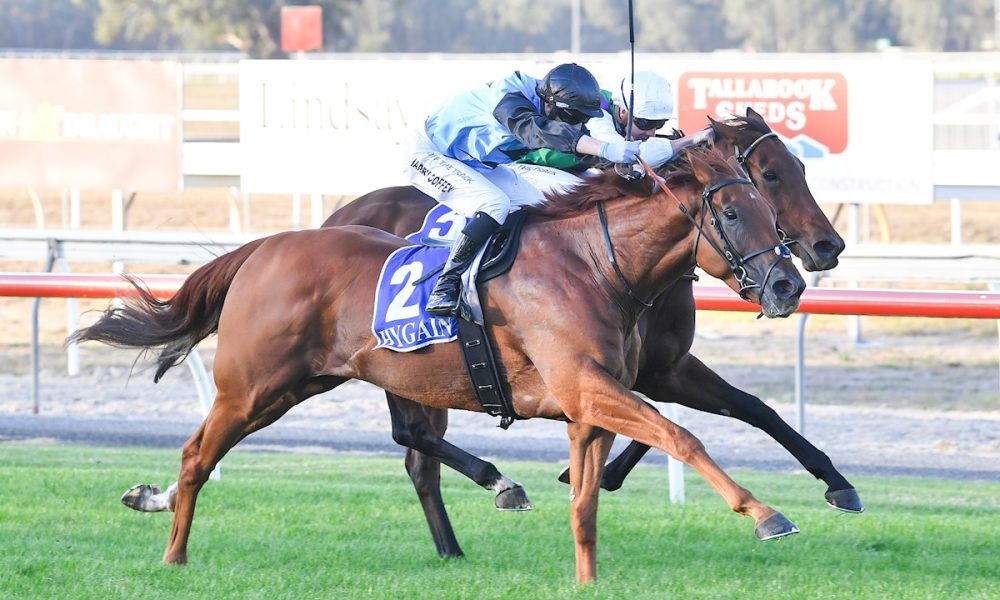
We’re not saying Caloundra Cup (Listed, 2400m) winner Half Yours (St Jean) is bred to get a trip or anything, but his grandsire Teofilo (Galileo) has left three Melbourne Cup (Gr 1, 3200m) winners in the past seven years, and his damsire fathered a certain mare who won three more.
Stay? Thought he’d never leave.
From the mother’s side, things look pretty plain. The four-year-old was bred by his original trainer Ciaron Maher and the late Colin McKenna, out of a mare whose best run in five was a second at Mount Gambier.
But the mare, misleadingly named La Gazelle, was at least by Desert King (Danehill), not only Makybe Diva’s dad but also a winner of the Irish Derby (Gr 1, 1m 4f) among three Group 1s.
Half Yours stepped up to 2400 metres for the first time in stunning fashion on Saturday, not just winning by 4.5 lengths and looking sweet for a second lap, but setting the second fastest last furlong of the program, on a day with seven races of 1400 metres or less.
The win set tongues wagging about greater riches in the spring, not least from his new-ish trainers Tony and Calvin McEvoy.
They had muscled in to buy him last November when he was auctioned online in a dispersal of McKenna’s stock.
It wasn’t one of those cheap pick-ups sniffed out online, with $305,000 the winning bid. Maher – who had trained Half Yours for two wins from five starts – was believed to be the underbidder, which will have pained him again last Saturday.
As for the sire of this emerging star, like the dam it’s another dive into obscurity. For the uninitiated, on seeing (IRE) beside the stallion’s name and watching Saturday’s race, it might have been assumed Half Yours had been bred in colder and wetter climes rather than, well, Victoria.
But Half Yours is by St Jean, who stands in the southern state, and has been doing so for eight years now.
It’s not too harsh to describe him as an unknown. In the past four years, St Jean has covered 26 mares, standing for $3,300 at Brackley Park, which perhaps had more fame as the breaking and spelling farm of the Freedman Brothers in their pomp than it does now.
But he does have the distinction of winning a race by 16 lengths, a 2400-metre maiden at Tramore in his home country of Ireland.
And but for the capricious fates of racing and breeding, St Jean could have achieved far more fame.
He was imported to Australia by trainer Aaron Purcell in 2013 and became one of those tough European stayers who enjoyed considerable success against Australasian-breds, winning four of his first eight runs here.
Three wins were in city class, with punters recognising his European staying talents by making him favourite each time.
In one 0-90 class affair in May 2014, he overcame barrier ten of 11 from Caulfield’s 2000-metre start. Canny observers of barrier stats will know that’s an extremely hard thing to do. But not only did he win, he sat wide without cover charging up the hill and around the bend, then parked outside the leader and still came away to score by two lengths.
He drew the outside of 16 at his next run, over 2400 metres on a Sandown Saturday, travelled three-wide without cover in fifth for the first 800 metres before tucking in one off the fence, and powered home in the straight to score by 2.5 lengths, looking more like a son of Teofilo the further he went.
After a spell, St Jean stunned second-up in the spring by coming from near last to win a 1600-metre open handicap at Moonee Valley, showing a ton of stallion grit in the straight to beat down the leader.
The St Jean genie was out of the bottle. But as stakes grade beckoned, fortune frowned.
St Jean damaged a tendon. Worse, he became a victim of Victoria’s ibuprofen drama, when several horses sent to a Gippsland rehabilitation farm for tendon troubles were treated with the drug.
Amid concerns over the type and dosage of ibuprofen used, the anti-inflammatory was found to have unpredictable clearance times. Reports said some horses were still testing positive more than a year after their treatment ceased. Some experts believed the drug was being stored up in affected horses’ livers, and then would be flushed out under strenuous exercise intermittently. Horses could test negative to it one day, and positive later on.
Under Victorian rules, affected horses would not be allowed to run until the drug was completely out of their system, since there’d be no way to distinguish between an old administration of ibuprofen and a more recent one.
The issue effectively ended the career of Lexus Stakes (Gr 3, 2500m) winner Signoff (Authorized). St Jean, in his absolute prime, didn’t race for more than two years.
Eventually, his connections had to think outside the square, metaphorically and geographically.
“Aaron Purcell’s father, who was in the horse, contacted stewards in New Zealand,” says Brackley Park’s Grant Dwyer. “He said, ‘I’m thinking of sending St Jean over there but he’s been banned from here because of ibuprofen’.”
Told the horse would be prepared by Donna Logan, the stewards approved the move.
“But they said, ‘If he wins a race we’ll test him, and if he tests positive you won’t get any prize–money’,” Dwyer said.
That punt taken, St Jean had four starts in New Zealand, and in the third became a stakes winner, with a typically tough, if narrow, victory in Ellerslie’s City Of Auckland Cup (Gr 3, 2400m).
He tested negative, but in his next start, he went in another tendon, and he was retired to stud aged seven.
Had he not gone to the ibuprofen farm, we would have seen a lot more of St Jean at his peak.
And had he stayed in Ireland, where there’s more of a thirst for staying blood, he’d have had far greater opportunities at stud, especially since he comes from that esteemed line of Northern Dancer-Sadler’s Wells-Galileo-Teofilo.
As it is, in speed and two-year-old hungry Australia, he’s sired all of 64 live foals so far, and covered five mares last spring.
However, Half Yours’s victory on Saturday, at start number ten, gave St Jean a stakes winner amongst just 22 starters. A total of 11 of those have been successful, although Half Yours also counts as his only metro winner.
“If he keeps going on his current rate,” Dwyer says, “if he gets another 50 mares he’ll have another couple of stakes winners.
“Hopefully, if Half Yours kicks on, he’ll get a reasonable sized book next year.”
When first brought to Australia, St Jean was syndicated by Purcell to a group including McKenna, the prominent owner and breeder who was also a friend of Dwyer’s. Though Dwyer laments never being in the ownership group, he says they “did me a big favour in letting me stand the stallion”.
Still, there are some harsh realities to standing stayers, as has been discovered by Dwyer, who also stands the near-retirement Murtajill (Rock Of Gibraltar), who also stood for $3,300 last year.
St Jean has never had a horse go through a yearling sale. And, with most bookings already in for this spring, Dwyer is “not expecting many mares this year”.
Backed by a strong pedigree – his Reine-de-Course fourth dam Highclere (Queen’s Hussar) is the third dam of the great Japanese stallion Deep Impact (Sunday Silence) – St Jean does have some admirers amidst the breeding community, but the landscape is tricky.
“I knew it’d be a tough gig, but life’s tough,” says the 63-year-old Dwyer, a former stockbroker with a history of selling yearlings as well as standing stallions at Brackley Park, which he bought in 1999.
“But I’ve always had faith the horse would throw something, because of his pedigree.
“He has a 50 per cent winners-to-runners ratio, though it has been up to 65 per cent. I follow all of his horses, and it’s profitable to follow them, but they don’t win until they get over distance.
“The horse is purely supported by people who want to breed a stayer and race it. They’re useless until they’re three years old, so there’s a bit of a wait involved.
“He gets very few mares, and the quality of the mares is what you’d expect when you stand for three grand, let’s put it that way.”
Dwyer also believes VOBIS incentives are “too much slanted towards two-and-three-year-old winners” with not enough stayers’ bonuses.
“The other thing at this end of the market is you’re dealing with people with a great passion to breed a horse, but not much money,” he says.
“So the horses perhaps don’t get broken in and put into the system when they should be; they’re in a paddock for a long time. Plus you tend to have a lot more paddock accidents.
“So, St Jean has done it the hard way, that’s for sure.
“But I do think it should be possible to breed good stayers in Australia. Hopefully, even though St Jean hasn’t had the volume, we can start breeding stayers in Australia and New Zealand who can win our staying races. We shouldn’t have to import stayers.”
Among the rising 15-year-old St Jean’s supporters, Dwyer says, are Warrnambool-based Purcell and Pakenham couple Kim and Gayle Mayberry.
“Kim and Gayle are trainers who breed their own and race them,” Dwyer says. “They keep sending mares to St Jean and they’re happy with what they’re seeing.
“They do take a while to develop, but they’re big, strong, correct horses. But of course it’s harder to keep a big horse sound than a small horse.”
McKenna was also a supporter of the stallion he part-owned, and in St Jean’s third season at stud, he got together with Maher for the mating that produced Half Yours.
Expectations will have been measured. Aside from her poor race record, La Gazelle had had seven foals before Half Yours for two bush winners.
Still, La Gazelle’s year-older half-brother was Moudre (Blevic), who won a Group 3, a Listed, and ran a top-tier third, aptly in the Makybe Diva Stakes (Gr 1, 1600m).
And this pedigree blend – layer upon layer of stayer upon stayer – appears to have hatched a horse who thrives over distance.
First catching the eye is that Half Yours has double Danehill (Danzig), in the best of the three possible combinations of that often tricky duplication – gender balanced – at 4f x 3m. Danehill is Teofilo’s damsire, and the father of Desert King.
Half Yours also has the great Northern Dancer (Nearctic) four times in his first five generations at 5m x 5m, 5m, 5m – and through four different sons in Sadler’s Wells, Danzig, Nureyev, and Be My Guest. That, and Danehill’s duplication, affects many mentions of Northern Dancer’s blue hen of a mother, Natalma (Native Dancer), who’s there eight times in Half Yours’ first seven removes.
He also has a rare-for-these-parts 5f x 5f of British stallion Bustino (Busted), whose staying prowess was shown in winning English features the St Leger (Gr 1, 1m 6.5f) and the Coronation Cup (Gr 1, 1m 4f) in the mid-70s. Bustino is the sire of St Jean’s third dam – that daughter of Highclere in Height Of Fashion, a Reine-de-Course mare herself – and of Desert King’s second dam Dish Dash.
Going back further, Half Yours has a 6f x 5m of another Reine de Course mare in Special (Forli), which never hurts, via Fairy Bridge (Bold Reason), dam of St Jean’s third sire Sadler’s Wells, and Nureyev, Desert King’s damsire.
So yes, Half Yours is bred to stay, and well bred at that.
His win in one of the few stakes races in the dog days of late July will have set off a few faint bells of recognition for St Jean, a stallion we might have come to know a lot better in his racing days than we did, barring a twist of fate.
If his current trajectory continues, transforming into major-race success for an Australian-bred against the tide of imported European stayers, he could really put Brackley Park’s stallion on the map this spring.