

‘I thought the sale was sensational’ – Leading industry figures provide glowing reports on Magic Millions
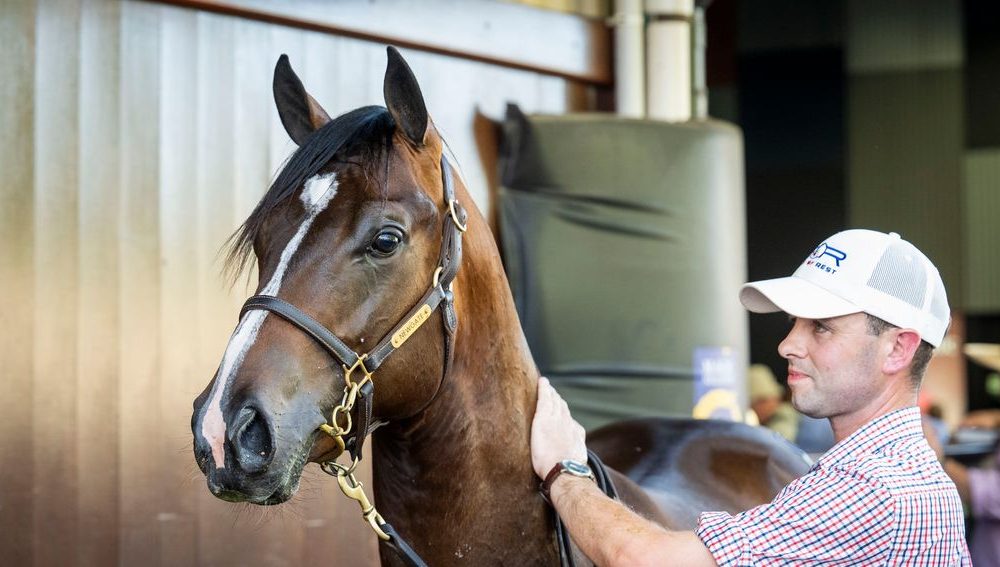
A “steady to strong” forecast for the rest of the Australian yearling sale season according to a range of industry figures, based on the results of Magic Millions Gold Coast.
Book 1 of the first sale of the year was hailed as an emphatic success by Magic Millions managing director Barry Bowditch. The sale’s average of $270,468 was up by around $1000 on 2025 – fulfilling some vendors’ projections of a similar sale to 12 months ago.
The clearance rate of 87.35 per cent – up from 83.05 per cent a year earlier – was what had several observers particularly impressed, leading to mostly upbeat projections for the sale season ahead.
Bowditch noted 45 buyers had spent $1 million or more, which “shows there’s a great thirst for yearlings in Australia”.
With the catalogue streamlined this year, Magic Millions was also buoyant over a Book 1 gross of $204 million through 753 lots sold, close to 2025’s figure of $207 million from 16 more yearlings.
Book 2 was markedly up, with an average of $51,466 over $44,198, and a clearance rate which on Monday – a day after the auction ended – stood at 84.04 per cent, up from 73.29 per cent year-on-year.
Furthermore, Book 2 had grossed $9.2 million from 179 sold lots, compared to $10.9 million from 247 sold lots in 2025, confirming most judges’ views that the bottom end of the market was the scene of robust trade.
That has spurred widespread expectations of pleasing results for vendors at Inglis’s two lower-end sales – Classic and Premier.
And industry figures canvassed by ANZ are also tipping a bumper outcome at Inglis’s marquee Easter sale.
That assertion is based on the middle market having been strong at the Gold Coast, and the fact that only 15 lots reached seven figures there – down from 22 in 2025 – suggests a relatively large number of elite yearlings have been saved for Easter. Three lots sold for more at the Gold Coast in 2025 than last week’s peak price of $2 million.
“I thought the sale was sensational,” said Peter O’Brien, general manager of Segenhoe Stud, the sale’s fourth largest vendor by aggregate, and third-highest by average. “The clearance rate was great, and overall the sale was buoyant all the way through.
“I was always confident about the top end of the market going in. All the main players were there and that was very strong.
“The middle market held its own. But the biggest surprise for me was the bottom of the market was stronger than expected. I thought the lower end of the market would be very difficult, and that the clearance rate would drop from last year.
“So that part really surprised me, and it’s very encouraging leading into the likes of Classic and Premier.”
He added: “Overall it’s very encouraging for the rest of the year.
“I think Easter will be very strong. That’s middle to top end, and that very much held its own at Magics.
“And then you see the number of million-dollar horses was down, but that’s a measure of farms supporting Easter – spreading those top quality yearlings out more.
“Easter will probably have more quality than Magics at the very top end. Easter was a very strong sale last year, and so a lot of the farms will have held back some top end horses for easter.”
Forecasts of a robust sale season were echoed by Henry Field, managing director of Newgate Farm, which was third on the vendors’ grossing list at the Gold Coast.
“It was a very good sale, with very good execution by Barry Bowditch and his team once again,” Field said.
“There was particularly good strength in the middle market, which I probably didn’t expect was going to be so strong, and the lower end horses exceeded our expectations. The clearance rate shows there was a very good market for horses across the board.
“I expect the rest of the sale season will be strong. Such a strong appetite for stock on the Gold Coast suggests the rest of the season should be good, plus there’s a lot of people who still have orders to fill.
“A number of different buyers made comment they still hadn’t filled their orders. That, combined with the Gold Coast clearance rate, says there’s plenty more money in the market.”
Prominent bloodstock agent and breeder Sheamus Mills took a slightly more measured approach. Just as the Magics’ Book 1 average was on par with last year’s, he said the sale reflected the wider Australian economy’s stable, unspectacular atmosphere, and tipped this would continue as the yearling sale season evolved.
“I think it was steady as she goes, which is what I was expecting” Mills said.
“We are reflective of the wider economy, and I don’t think there were any dramatic shifts in the wider economy, and that was probably always going to be the case as far as our own bubble inside that goes.”
Unlike the boom year of 2022 when buyers were cash-rich after spending curbs during Covid, Mills said the market was currently characterised by far more middle ground.
“I don’t think anyone feels rich and no one feels poor,” he said. “As far as I can tell from my own clients’ interest, there’s still a level of hesitation as to where the economy sits. And investment inside the industry is still at a cautious level.
“I think the rest of the season will be pretty much the same. I don’t think there’s any dramatic shift due any time soon.
“My guess, and my feeling from my own clients’ interests, is they’re happy to play to a level, but I don’t see any massive new investment.”
Mills, like others, noted no major new buyers had emerged at the Gold Coast, like American John Stewart had done in recent years, and said none were likely in the remainder of the season.
He also added that some years of stability in the market would “not be the worst thing in the world”.
“That insatiable desire for record, record, record, every year – I think it’s a double-edged sword in that it does as much harm as good,” he said.
“We did reach a place where a lot of people were saying yearling prices were out of control. I take a slightly different view – the cost of production prices are the issue, not the yearling sale prices.
“The whole cost of getting a yearling to a sale has risen, not only in service fees but associated costs – monthly bills, from stud farms or trainers. They keep going up.
“A few years of steady as she goes might settle the market a bit. In terms of confidence from both sides, steady results are not a bad thing at all. From an investor’s point of view, if they can just make a rational assessment on whether it is possible to make money in the game, to be a breeder and make it viable – and I’m talking about people who don’t own stallions – I think that’s good.
“The constant advertisement of record this and record that, I don’t think it does a lot of good for the industry.”
Mills, who felt the competition in the market at the Gold Coast from the fact he bought four yearlings of a hoped-for seven, said the “hugely important” clearance rate was “the most pleasing aspect of the sale”, and was aided by vendors setting more realistic reserves this year.
“A total of 11 vendors sold million-dollar yearlings, but I would say, ‘Who cares?’ I understand why that makes news, but I would say things like clearance rates are a much more important factor,” he said.
Waterhouse-Bott were the busiest buying stable at the Gold Coast, purchasing 17 lots with Kestrel Thoroughbreds for a combined $7.03 million.
Despite their haul, Adrian Bott said his team missed out on several “due to the strength of the market”, which was a sign the rest of the sale season would also be upbeat.
“I usually think the Gold Coast does set the tone for the rest of the year,” Bott said. “So I’d expect that to hold up all the way through, and that the market will be strong. I certainly can’t see it going backwards.
“And I don’t think remaining at the same average as last year is necessarily a sign that things have softened. I think the last few years have been particularly strong, and I think that’s still the case.
“The market seemed very healthy at Magics. We had to be strong on the right horses and we were selective with what we were able to buy. With the horses we were on, there seemed to be a lot of competition, at all different levels.”
Bloodstock agent James Harron – who was involved in the buying of nine colts and three fillies – was another forecasting positive results for the rest of the sale season, robust enough at least to keep parity with 2025.
Applying his own reliable metric – “how long it took to queue up to get lunch” – Harron said the Gold Coast benefitted from “a lot of engagement”, which he expected to continue through the sale season.
“From the first lot to the very end, the whole place was full. It might have been a record attendance,” said Harron, adding that scheduling the post-festive season auction a week later than last year will have “helped more people get organised to get there”.
“The sale was fantastic – very buoyant. I was pleasantly surprised with how well the market held up across the board right through Book 2.
“It felt like a very fair market. If there was going to be a weak spot in the market it would have been Book 2, but by all the metrics that was very successful.
“It sets the tone for the whole season, and I think it’s a great indication of a good year to come. I think it will probably be holding its own on last year.
“The top end we’ll see right through the year being very strong. Easter is setting itself up to be really, really strong on those big lots. But if we can see that low-to-mid level continue as it was this week, that’ll be really important, particularly for Classic and Premier.”
Syndicators were also busy at the Gold Coast, with Star Thoroughbreds the most active in securing 11 lots for $2.94 million, the fifth-largest buyer overall.
“It was a typical Magic Millions sale,” said Star boss Denise Martin. “There was lots of quality, and lots of interested participants, and a lot of people attending for the first time.
“It felt very similar to last year, and I’d say the rest of the year will be very similar to Magic Millions.”
Triple Crown Syndications, who bought nine yearlings, expects a vigorous market for the next few months, based on Gold Coast metrics.
“It was as strong as ever,” said Triple Crown director Sam Mannion. “We don’t feel there was any sort of dip this year at all. Particularly for those middle range yearlings, we thought it was particularly strong.
“It’s as tough as ever. In that mid market where we play, anything from $100,000 to $350,000, it was strong. We were underbidder on a fair few, but we stuck to what we were going to spend.
“In theory, 2026 is as strong as ever. As the year goes on, people will die off a little, but in the first four or five months, it’ll be strong.”