

Makybe Diva
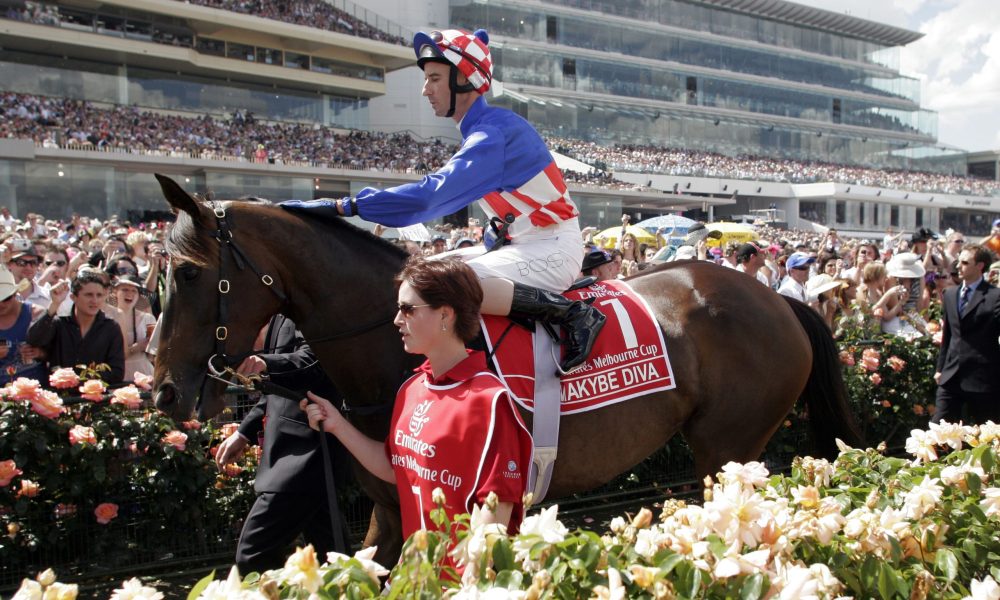
The Melbourne Cup (Gr 1, 3200m) is not just Australia’s greatest horse race, but a national phenomenon.
British racing folk may marvel, or even wince, that such status belongs to a handicap – or even that it’s a Group 1 – but the quirky evolution of egalitarian Australia has made it so; where the fabled battler from the bush whose own backyard horse getting in with a feather weight has as much chance as the blue blood owned by a sheikh or a prince. As the country grew from a penal colony, we just didn’t have the population for a class structure. The Cup bloomed for its mass appeal, and its level playing field.
Over 175 years, through wars, depressions and other upheaval, the Cup has always been there, a two mile constant to which the country has turned its focus on the first Tuesday of November at Flemington. We still call it “the race that stops a nation”. Sadly, that’s not as true as it once was. Schools don’t stop any more to run a classroom sweepstake. It’s a different world, and we’re poorer for such a loss of unique cultural colour.
Still, the Cup – which has been an international event since 1993 – remains this country’s largest and most enduring cultural institution. It still stops ‘most’ of the nation.
That’s why, when this colour hadn’t faded quite so much, in the heady spring of 2005 the country was agog as one beloved mare did what no horse had done. Makybe Diva (Desert King) became the first to win the Cup three times.
Flemington went berserk as it had never done before, with 106,000 patrons chanting “Di-va … Di-va” when jockey Glen Boss parked her before the grandstands for minutes as she took in her ovation.
She’d been front and back page news for the days leading up to the race, and led every bulletin in the country hours after her triumph.
A friend of this correspondent was unlucky enough to be on a flight when the race was run. In a scene no doubt repeated elsewhere in the skies above this broad land, moments later came a very brief message from the pilot: “Ladies and gentlemen, this is your captain speaking: She did it!” The aircraft erupted with cheers and applause.
And this is why, 21 years later, many Australians were led to reminisce, when the great mare died last week. Even though she’d had a fantastically long innings – age 27 – her passing left many in tears.
“I had heaps of people ringing me up, to share condolences,” says John Foote, a man at the heart of her story. “Like when people die, it was sad but it was also a celebration of her life.
“Some people were crying – including one person who was really close to the action. It was nice actually, we had a nice chat, but he was very upset.”
Foote won’t divulge the man’s name “or it might embarrass him”, but it’s odds-on it was Tony Santic, the maverick tuna fishing baron from South Australia, who fled Croatia as a child in the turbulent years after World War II and became a great immigrant success story, and who owned the mare.
The multi-millionaire decided to take up racing and breeding as a hobby in the late 1990s, and didn’t do it by halves. Foote – one of Australia’s best known bloodstock judges and agents – became his man. Very quickly, Santic’s thoroughbred stocks reached triple figures.
In December 1998, Foote went to England to attend the Newmarket Broodmare Sale, with a (fairly broad) brief to buy Santic one or two breeding propositions.
“Tony was going to be 300 miles offshore on his fishing boat, so he’d be hard to reach,” Foote says. “So he just said that I should use my judgment and common sense and buy something good.”
Foote circled a couple of dozen mares. One he was drawn to was Tugela. She was by Riverman (Never Bend), and hence named after a river in South Africa.
The four-year-old was carrying to the young sire Desert King (Danehill), winner of the Irish Derby (Gr 1, 1m 4f) and two other top-tier events. Tugela had been no star on the track, with two starts in England for a last and a second last.
Foote liked that she’d been bred by one of the most respected names in global breeding – Juddmonte – and was from a well proven old family of theirs, stemming from the US, where Tugela and her first five dams had been bred.
Tugela’s dam Rambushka, also bred by Juddmonte, had won in black-type company in Newcastle’s Virginia Stakes and finished second at the same level. Second dam Katsura had a pair of Irish Group 3 placings to her name.
Explaining why he’s a regular at British broodmare sales, Foote says: “One of the reasons to buy there is the families. They’ve got these wonderful families that have produced stakes winner after stakes winner.
“They’ve been breeding for so long there – more than 300 years. They know what works and they’ve gotten rid of most of the garbage.
“Plus, in Britain and Ireland, they don’t fiddle around with their black type, like we do in Australia, where we’re always adding Group 1s and upgrading races that probably shouldn’t be. That’s why you see horses who’ve won Group 3s or Listeds in Britain come to Australia and win Group 1s.”
And so Tugela’s poor racetrack record mattered not to Foote, nor the fact she was in-foal to Desert King.
“She just had great blood. Riverman was a fantastic broodmare sire,” he says of the stallion with a 10.2 per cent stakes winners to runners ratio in that category. “And then Tugela’s dam was by Roberto, and her second dam was by Northern Dancer. Wonderful sires and wonderful broodmare sires.”
While the bloodlines were attractive, just as important was the mare in front of him.
“It’s hard to describe buying horses. A lot of it is intuition,” says Foote, now 73.
“The nature of a mare is pretty critical when you buy them. You never know for sure, but I tend to think people are the same; the people with good natures tend to be the best parents.
“Tugela just had a lovely nature about her, a kind eye and she was easy to do anything with.
“Also, the fact she’d only had two starts didn’t bother me. When I buy yearlings, I’m very hesitant to buy them out of mares who’ve had a lot of racing,” he explains, adding perhaps all that physical strain could take too much from a body.
“Tugela had raced at two, and when I saw her she was three. I imagine they might have raced her a bit too soon.
“She was a little bit offset in both knees, but that was easily forgiveable.”
He adds: “While she wasn’t that big, unlike most Rivermans, she had a lovely head and disposition.
“But also, for a mare in foal for the first time, she was actually quite gross. It’s a good sign when they let down nice and quickly. It often takes a foal or two for mares to let down properly, but she’d done it already. In fact, she looked like a jersey cow!
“I didn’t mind the fact she wasn’t overly big. The sorts of stallions we have in Australia – big, strong, tough-looking Danehills and things like that, I thought she would suit Australia. I wouldn’t go to England and buy mares that are big and heavy. I like the more refined ones for our part of the world.”
Now, Foote just had to acquire her.
After the very round Tugela swayed into the Newmarket sales ring, Foote found himself in a battle with three or four others who’d also spied her. Bidding passed 50,000gns, and continued upwards until Foote bid 60,000gns. It transpired to be the final offer.
“That was going to be my last bid,” Foote said. “I thought that was about right. It was about a mid-range price at that sale. Others sold for higher, but I think Tugela’s lack of racetrack success kept her price down. In any case, I wasn’t going any higher.”
Foote and Santic had planned to let Tugela have her Desert King foal and leave it in England. After the filly was born and weaned, Tugela was duly flown to Australia, and the filly entered for the weanling section of that same broodmare sale one year on, in December 1999.
Here’s where a historic bit of fortune came into play. Foote had never been to the foal session before, and hasn’t been since. But aside from Tugela’s filly, the other mare he’d bought for Santic a year earlier – Mutribah (Silver Hawk) – had also had a foal that needed selling.
“So this time I went over a couple of days early, and when I saw Tugela’s filly, she looked good,” Foote says. “She was good sized, strong enough, a bit on the skinny side but she moved well. She moved really well.”
Foote and Santic agreed on a reserve of 20,00gns. If she didn’t reach it, she’d be going to Australia to race. The bidding reached 14,000gns fairly quickly, and it looked like she’d be going to a local home. But after it hit 16,000gns, it stopped.
The filly soon found herself following her mother’s path to the antipodes.
Santic usually liked to name his own horses but this time, on a whim, he threw it to the five women in his tuna fishing office. MAureen, KYlie, BElinda, DIane and VAnessa each contributed the first two letters of their name.
The rest is glorious history.
Makybe Diva, the British-bred mare with the unusual name that soon became a household one, not only won her three Melbourne Cups – beating Dermot Weld’s outstanding stayer Vinnie Roe (Definite Article) into second in the middle one – but four other Group 1s and four other stakes races, from seven furlongs to two miles.
She won Flemington’s Australian Cup (Gr 1, 2000m), in what was considered a world record time of 1:58.73, and 12 days before her third Melbourne Cup, she won one of the most memorable editions of the Cox Plate (Gr 1, 2040m), when a wall of seven horses took off together half a mile from home to try to upset her, but still didn’t manage to.
While Makybe Diva, like so many great racemares, didn’t fire at stud, the family kept giving. Tugela emerged as a superb purchase by throwing three other stakes winners.
Her third foal, Valkyrie Diva (Jade Robbery), won a Group 3 amid eight victories from her 16 starts. Next out was a colt named Musket, by the great Redoute’s Choice (Danehill), won a Group 2 and she was also the dam of Listed winner La Amistad (Redoute’s Choice).
Valkyrie Diva bore three stakes winners. They included the gelding Jolly Banner (Lonhro), who took a Group 3 and was Group 1-placed in Hong Kong, while her Listed-winning daughter, C’est Beau La Vie (Bernardini), was back in the news recently when her son, Cap Ferrat (Snitzel), landed last March’s Hong Kong Derby (Listed, 2000m), having placed twice in elite company when trained in Australia.
And so Foote’s purchase of Tugela has paid handsome dividends – but none that can match one of the top few moments in the long and rich history of the Australian turf, which played out amid wild scenes at Flemington on November 1, 2005.
Of the part he played in it, Foote says: “It’s a good feeling, but it could’ve happened to anyone really. You’ve got to have a fair bit of luck when you’re buying horses, that you buy the right one.
“It was an intuition buy, and I was just fortunate I stumbled across the right mare. That’s pretty much it.”
* To purchase your copy of Trevor Marshallsea’s critically acclaimed book Makybe Diva, click here.