

Ferivia
David Brook, 77, is one of those outback cattlemen with landholdings the size of a European country.
Specifically, it’s Belgium, with five cattle stations totalling around 30,000 square kilometres, or about half the size of Tasmania.
He’s also the president of one of Australia’s most iconic race clubs – Birdsville – which is gearing up for its annual meeting on September 5 and 6.
Brook has held executive positions with the club for more than 50 years. Without wanting to make jokes about multi-tasking in small towns, his wife Nell has also had turns at being president and secretary, while son Gary is vice-president.
“The family’s been mixed up in it for a long time – my uncle, my dad, my son, my wife,” Brook tells It’s In The Blood. “There’s not many people out here who want these jobs, but everyone wants to keep the racing going.”
Living out in the bush, making sure your 40,000 animals are ok, things can get a bit quiet at night. Thankfully, there are pedigrees to pore over – not just about Poll Hereford cattle, but thoroughbred horses.
Brook loves to delve into the grand puzzle of breeding racehorses. With the aid of some software tools, he goes back nine, sometimes 15 generations.
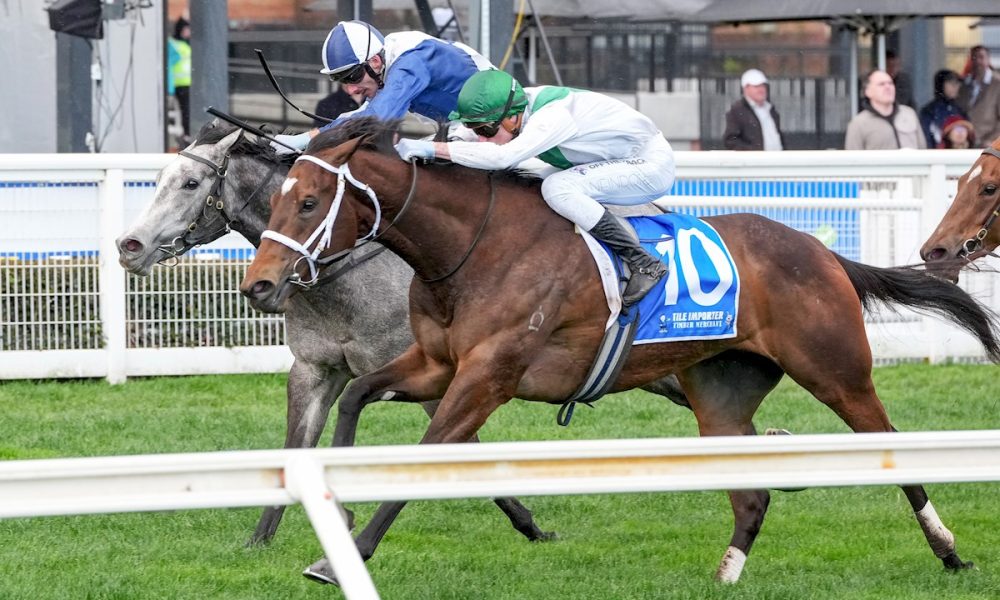
But he doesn’t like doing it the “easy” way, by throwing money at the problem, and he looks like he’s bred a good one in Ferivia (Astern), winner of last Saturday’s Quezette Stakes (Gr 3, 1100m) at Caulfield.
“David can afford to buy anything,” says the filly’s trainer Phillip Stokes, “but what he likes to do is breed something inexpensively, that he can put a bit of thought into.”
Or as Gary Brook relates: “Dad has always said, ‘Anyone can go to a sale and spend half a million dollars and expect to have a good one, but the real challenge is trying to get a good one from spending not much money’.
“It’s that challenge that he’s into. It’s a thrill to try to get something that way. Over time, he’s probably done a really good job at producing horses that can win that aren’t that expensive.
“We haven’t had superstars, but we’ve got horses who win races. We get great enjoyment from winning a race anywhere – if that happens to be Birdsville fantastic. If you can get winners in Melbourne or Adelaide, that’s a bonus.”
David Brook and his wife and five offspring race Ferivia and others in a syndicate known as Saddlers Knife – since the outline of one such tool forms the brand on the family’s cattle and horses.
He owns around 12 broodmares, and might have bought one yearling in the past 20 years.
Brook’s breeding methods have brought the family the winner of the past two Birdsville Cups (1600m) in Neodium (Terango), prepared for the second of those by Stokes. That’s given them seven such trophies since 1982 – deserved reward for their work in running the club.
And it was also that just-mentioned sire perhaps none of you will have heard of in Terango (Akhadan), a stallion who left 30 live foals in nine seasons, who’s responsible in a roundabout way for the existence of Ferivia.
Brook bought Terango at the Magic Millions’ Adelaide Yearling Sale in 2004 for $6,000. Trained by David Balfour, he won seven races and was placed twice in Adelaide Group 3 sprints – behind Here De Angels (Dehere) both times.
The Brooks never had huge designs on Terango becoming a stallion but equally, they never got around to gelding him.
“He was just the quietest stallion you’ve ever met. He didn’t know he was a stallion,” Gary Brook says.
“After he finished racing we sent him to one of our stations, and Dad bred him to a couple of station mares for stock horses. Then we thought we’d see how he went with thoroughbreds.”
Terango went to Strathwood Park at Woodchester, south-west of Adelaide, and covered a few mares each season, most sent from David Brook. One of them was Serene Lass (Not A Single Doubt), who Brook had sniffed out for $2,000 from a dispersal sale amid the fall-out from the Patinack Farm debacle in 2012.
Serene Lass went to Terango for five straight years and the second cover yielded Terbium, a grey gelding who for the Brooks and Stokes won the 2019 Zeditave Stakes (Gr 3, 1200m) at Caulfield, upsetting $1.40 hot pot Zousain (Zoustar) in a five-horse field.
The third of those covers produced a horse with just as fine credentials for the Brooks – dual Birdsville Cup winner Neodium, another grey.
And so Brook was so pleased with how his Not A Single Doubt (Redoute’s Choice) mare had done with his mild mannered stallion Terango, he bought a few more.
One was Streetcar Express. She’d been through a sale as a $100,000 weanling, but after a nine-start career highlighted by two seconds at Strathalbyn – and a hot habit of buckjumping – Brook was able to buy her privately for considerably less.
There was, despite her record, some class in the family. Her dam Streetcar Stella (Blevic) had only managed a Balaklava maiden win, but her dam Stellar Fille (Filante) had thrown two lower–level South Australian stakes winners – Streetcar Isabelle (Danerich) and Streetcar Magic (Blevic).
In 2019, Brook duly put Streetcar Express to Terango, and the result wasn’t great. Gelding Effline won one of five, at Charleville, and was retired this year.
But Brook raised his sights and his budget, perhaps just this once, and next sent Streetcar Express to Pride Of Dubai (Per Incanto), then standing at Coolmore for $38,500 (inc GST). The result was Effusiv, a late-blooming four-year-old mare who’s won one of three for Stokes, at Balaklava.
Next up, Brook sent Streetcar Express to Astern (Medaglia D’Oro), thanks to an earlier conversation, during a Hunter Valley tour, with Darley stallions manager Alastair Pulford.
“Dad asked him who their best stallion was at the lower end of the price scale, and he said ‘Astern’,” Gary Brook says.
Standing for $16,500 (inc GST) in 2021, Astern fitted Brook’s more usual budget. But on top of that, the mating with Streetcar Express produced a series of tricks that entranced Brook Snr, and which appear to have worked through the resultant offspring, Ferivia.
The filly’s first five generations are highlighted by three duplications. Two in particular look to have had a powerful impact, with the sire’s dam and the dam’s sire being closely related.
Astern’s dam Essaouira (Exceed And Excel) and Streetcar Express’s sire Not A Single Doubt both have Danehill (Danzig) as their grandsire and Rory’s Jester (Crown Jester) as their damsire.
This means Ferivia has Danehill at 4m x 4m, and Rory’s Jester at 4f x 4f. While doubling Danehill through two sons is the least successful of the three possible ways to do it, David Brook believes this pairing with Rory’s Jester could have struck a winning combination.
Going back, the pair have a couple of the same ancestors from the 1930s reinforced in their fifth remove, in British sire Fair Trial (Fairway) and, perhaps more importantly, grey French stallion Mahmoud (Blenheim).
Ferivia’s other duplication in her first five generations is Sadler’s Wells (Northern Dancer) at 4m x 5m.
Coming in powerfully through the sirelines of Astern and Ferivia’s second dam Streetcar Stella, it doesn’t touch the Danehill-Rory’s Jester cluster in the middle, but brings another line of Mahmoud.
With a couple of other descendants present, Mahmoud appears 15 times overall in Ferivia’s first nine generations, mostly in the ninth, and through five different offspring. Importantly, they’re four daughters, with one appearance from a son.
And Mahmoud is the damsire of the great blue hen Natalma (Native Dancer), who’s there a useful 11 times in Ferivia’s first nine removes.
“That blend of Mahmoud, I’d take that any day,” says Brook Snr.
“Mahmoud is the base of a lot of pedigrees, and his markings often transfer right the way through. If he’s in the female side, they just keep coming through, and you get a lot of greys, like Mahmoud was. I tend to have had a bit of success with greys. I believe in them.”
Closer in, Brook said he was drawn to the Ferivia mating, as is often the case, by “a bit of in-breeding”.
“Essaouira and Not A Single Doubt, to me, are like brother and sister,” he said. “And the two Danehill sires involved – Exceed And Excel and Redoute’s Choice – are probably the two best Danehill sires we’ve seen in Australia.
“Then you have Rory’s Jester, who’s proven to be a good sire with a bit of speed.
“And I liked the double of Sadler’s Wells, through El Prado [Astern’s grandsire], and Blevic [Streetcar Stella’s sire]. Blevic has a good record siring stayers, and Streetcar Stella is out of a Filante mare, so that gives me hope Ferivia might run further than 1200 [metres].”
Ferivia has been a little hot like her buckjumping dam, but the Stokes stable has worked hard to make her more settled, with the results evident last Saturday, her second win in three starts alongside a narrow Sandown second.
Stokes, too, believes the three-year-old can succeed over a longer distance, and perhaps might measure up to a Guineas.
Last week, he’d modestly flagged that the Morphettville Guineas (Listed, 1600m) next March might be it. But after she stormed home from the rear at Caulfield on Saturday, it’s likely there might be a more prestigious target on the horizon, in the Thousand Guineas (Gr 1, 1600m) at Caulfield in October.
Meanwhile, Astern has taken up residence in Turkey, his seven stakes winners from 225 Australian runners – even including Group 1 victors Golden Mile and Affaire A Suivre – not enough to spare him from the Darley exit door.
But at least in the intricate twinning with former hot-headed maiden Streetcar Express that produced Ferivia, he appears to have done the trick.