
NZ National Yearling Sale celebrates 100 years
The show must go on
A significant milestone is about to take place this week, namely, the 100th New Zealand National Yearling Sale.
For 99 unbroken years, auctioneers, buyers, vendors and yearling thoroughbreds have shown up at either Trentham or Karaka as the display window of the New Zealand breeding industry. Any number of reasons could have interfered with the 99 consecutive years of sales yet every one was conquered. From the beginning, the National Sale confronted a variety of hurdles starting with the The Great Depression which severely impacted sales of the early 1930s. The escape from the depression’s clutches was brief as the globe was soon plunged into World War II.
Along the way events such as fuel rationing, finance restrictions, Australian government purchase quotas, changes of governments, weather bombs, floods, dust storms, the stock market crash of 1987, the Gulf War, the global financial crisis and, most recently, a world pandemic, not one was able to derail the sale from being staged.
Twice the sale was delayed. In 1936 the death of King George V pushed the sale back a few days while the country mourned. In 2022, the pandemic set the sale back by five weeks. The latter came closest to breaking the sequence and very nearly succeeded but it is a testament to the auctioneers that they somehow found a way to keep the show on the road, much to the relief of breeders and vendors. When the first sale was held the auctioneers could not have imagined that 100 years on, the event would maintain its status as the showcase of the New Zealand breeding industry.
An innocent question
New Zealand studs bred thoroughbreds long before the first National Sale but sales were held regionally, at studs or at race meetings. Among the more prominent breeders was George Currie and his Koatanui Stud near Wanganui who imported and stood highly successful stallions Absurd (Sundridge) and Limond (Desmond). He also imported New Zealand Hall of Fame broodmare Eulogy (Cicero).
Currie was ahead of his time and by rail and sea sent a high proportion of his annual draft to the Sydney Easter Yearling Sale. His involvement with the New Zealand National Yearling Sale was a huge factor behind its foundation and subsequent success but it was an innocent question by Wright, Stephenson & Co’s Feilding stud stock representative Harry Toose which may have been the catalyst for the sale’s existence.
At a private yearling sale at Waikanae (near Wellington) he turned to his boss, Charlie Robertson, and asked: “Why can’t New Zealand have a national sale?” Whenever Robertson raised the idea with breeders the feedback was positive. Currie, along with WG Stead (Flaxmere Stud), TH Lowry (Okawa Stud), JD & F Ormond (Karamu Stud), IG Duncan (Elderslie Stud), JF Buchanan (Kinloch Stud), AF Roberts (Seadown Stud) and J Donald (Westmere Stud) agreed and the first sale was staged on Friday, January 21, 1927.
The Trentham racecourse birdcage served as the venue for the first four sales. Four auctioneering companies and two catalogues were involved. Wright Stephenson & Co, Wellington in conjunction with H Chisholm of Sydney produced one catalogue while Pyne, Gould, Guinness Ltd, Christchurch teamed up with Sydney’s Wm Inglis & Sons on a second catalogue.
A press release in December 1926 included a comment from auctioneer Ken Austin: “No higher class collection of yearlings has ever been offered than these, whose particulars are fully set out, for they represent practically every well-known breeder throughout New Zealand. This sale affords buyers a great opportunity of acquiring yearlings from the most fashionable and successful lines of blood in the Dominion.”
A coin toss to determine which catalogue would be sold first was won by Pyne, Gould, Guinness and first lot, a filly later named Little Gift (Archery), was sold for 55gns at 11:30am. She was a winner at Gisborne as a four-year-old. At 1:00pm the sale paused for lunch!
Lot 1 of Wright, Stephenson’s catalogue fetched 600gns and was later named Shot Silk (Leighton). His record included winning twice on the same day at Marlborough.
From Trentham to Karaka
In 1931 loose boxes and an outdoor sales ring were built adjacent to the junction of the chute and the home straight of Trentham racecourse but by that time there was just a single catalogue. Wm Inglis & Son dropped out, yet returned in 1935 replacing H Chisholm & Co. From 1941 until 1972 the sale was held jointly by Wright, Stephenson & Co and Pyne, Gould, Guinness. A renamed Wrightson NMA Ltd and Pyne, Gould, Guinness ran the sale jointly until 1978 but in 1979 the sale was a one company affair, Wrightson Bloodstock Ltd. The new company appointed four directors. Managing director was Michael Floyd who was joined by Peter Kelly, Joe Walls and pedigree maven Pat O’Brien.
Floyd joined the company as an office junior in 1953. Ten years later he rose to general manager and when the bloodstock division of Wrightson NMA Ltd became Wrightson Bloodstock Ltd, Floyd was named managing director. He remained at the helm until 1992 employing many new and innovative ideas which strongly benefitted the company and the industry. He was responsible for opening up the Asian market and his input and drive was such that he was inducted into the New Zealand Racing Hall of Fame in 2023.
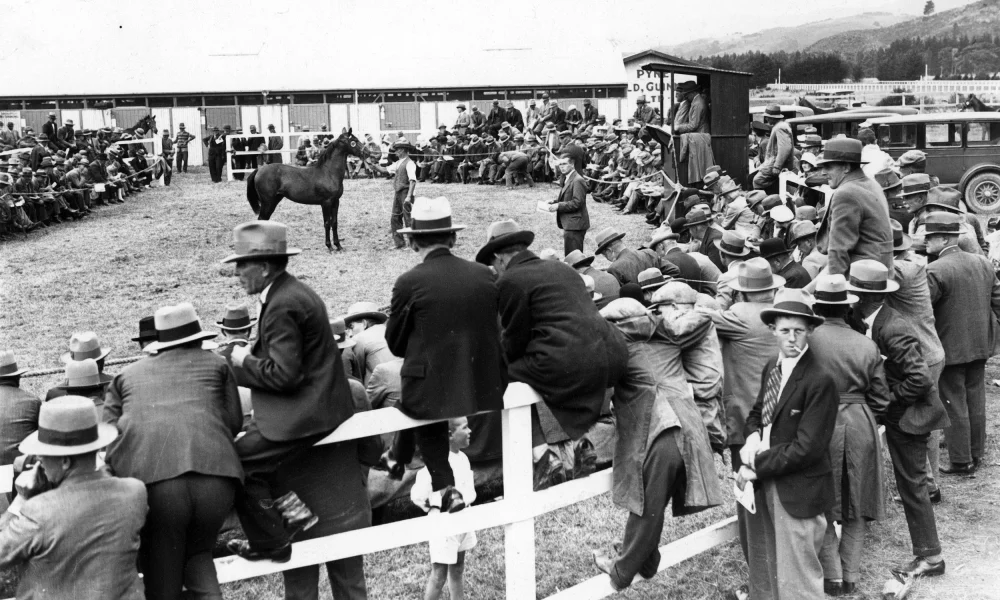
Until 1960 the yearlings were sold outdoors. The auctioneers huddled in a tiny booth while the public sat in a ring which could be covered with tarpaulins if it rained. A covered arena was often talked about. A massive dust storm in 1960 caused auctioneers Dave Clarkson and Bill Paterson to both lose their voices part way through day two. Retired Pyne, Gould, Guinness auctioneer Gordon McCredie came to the rescue and completed the sale. By the following year a purpose built pavilion was constructed and bad weather, which still occurred, became less influential on proceedings.
Sixty-one sales were held at Trentham, the last in 1987 but as early as 1969 there were questions raised as to whether the central New Zealand location was in the best interests of buyers and vendors especially, as there had been a gradual migration of the breeding industry, north to the Waikato region.
Rumblings about moving the sale continued, the issue leading discussions again in 1976 and again in 1981. One of several feasibility studies favoured Ellerslie as the new home but Wrightson Bloodstock’s managing director Michael Floyd was wary regarding renting or leasing land, believing that the company needed to have complete autonomy regarding their business operations. In 1986 the auctioneers announced the purchase of 34.4 hectares of prime land approximately 40 kilometres south of Auckland, next to the Papakura exit of the Southern Motorway, the site now known as the Karaka Sales Complex.
Designed from the ground up, the new venue included a bold new concept of auction selling. The auditorium features “the wall”, behind the auctioneers which made auctioneering much more efficient as all bids were in front of the rostrum. Also, a buyer could follow a yearling from the outside parade ring to the covered parade ring and right through to the sales ring. Peter Kelly, chief auctioneer at that time, believed it important to be able to “eyeball” the buyer.
The grounds allowed for ample vendor parade areas and the boxing was state of the art with indoor alleyways and sliding doors. In a surprisingly compact layout, each barn is within close proximity to the auditorium. Floyd, along with architect Rod Macdiarmid travelled the world, visited all the major sales venues and gathered together all the best ideas for the complex. To this day it is recognised as the leader in terms of efficient function and design.
Under new management
Some time in 1996, Wrightson Bloodstock’s parent company Fletcher Challenge Corporation offered the company for sale, explaining that bloodstock no longer fitted their overall profile. William Inglis & Sons were understood to be interested but there was a general belief and desire that the company should remain New Zealand-owned. A small group of breeders raised the necessary funds to buy the company, however, after making approaches to further breeders the deal foundered.
In December 1996, the Vela Brothers, owners of a hugely successful fishing and export business, stepped in to buy the auction house. Peter (now Sir Peter, ONZM) and Philip, long-time clients and close associates of Cambridge Stud’s Patrick Hogan, decided, as a bridge, to own and run the business for two years so as to allow a breeders’ consortium to take over once their finances were in order but such efforts came to nothing and the Velas became the permanent owners, operating as New Zealand Bloodstock. Joe Walls retained his post as managing director. The 1998 sale was the first over which the new owners had complete control, from taking entries through to the sale itself.
Current managing director Andrew Seabrook joined Wrightson Bloodstock in 1992. When the Vela Bros took ownership, Seabrook held the position of financial controller but was promoted to general manager in 2002. By 2008 he rose to be co managing director (bloodstock & finance) and in 2016 assumed the post of managing director.
The incentives
A significant incentive was the introduction of the $1 million Karaka Million (RL, 1200m) for two-year-olds, announced before the 2007 sale which was set to be run the following year. All NZB sale graduates were eligible.
Three of the winners were truly memorable and were consecutive. Melody Belle (Commands) was in command in 2017 and would ultimately score 19 wins, of which 14 were Group 1s. She was joined a year later by Avantage (Fastnet Rock), also an outstanding performer whose record included nine Group 1s among 16 career wins.
In 2017 the auctioneers announced a sister race for three-year-olds, named the Karaka Millions 3YO Classic (RL, 1600m). Probabeel (Savabeel) cemented her place in sale, as well as Karaka Millions history when she landed, not only the 2YO Millions, but returned the following years to score the sister race. Probabeel raced very successfully against the best in Australia and took out four Australian Group 1s as part of a 13 win haul.
Taking incentives into the stratosphere, prior to the 2024 sales series, NZB in conjunction with New Zealand Thoroughbred Racing (NZTR) and Entain/TAB announced The NZB Kiwi, a slot race for three-year-olds conceived, bred or sold through NZB. Funds for the $3.5 million race over 1500 metres were raised by an auction, entitling successful bidders a slot in 2025, 2026 and 2027.
The inaugural winner was Damask Rose (Savabeel), who also won the 2025 Karaka 3YO Classic. All four fillies were purchased by Te Akau Racing’s David Ellis. Three have been commemorated in the NZB’s Best Performers catalogue, published in conjunction with the centenary.
From the rostrum
Auctioneers Ken Austin and Reg Inglis Snr were the early voices followed by Charlie Robertson and Gordon McCredie. Later still, Robertson was joined by Bill Paterson and Dave Clarkson until Robertson’s retirement in 1955. Paterson and Clarkson were joined by Peter Kelly in 1961 and in 1972 Kelly took over as chief auctioneer after Paterson’s and Clarkson’s retirements. Joe Walls assumed the responsibility in 1990 and he was succeeded by current head auctioneer Mike Kneebone in 2020.
Ken Austin died in late 1959. One of the auctioneers at the inaugural 1927 sale, Austin was known prior to the setting up of the National Sale. He was auctioneer for H Chisholm & Co then assisted Wright, Stephenson & Co when Chisholm ceased their involvement. Later he managed Elderslie Stud before setting up his own Inglewood Stud. Austin was a giant in the bloodstock and sales industry. His experience, talent and knowledge were revered even apart from his great success as a breeder and he was duly recognised by the industry when inducted into the New Zealand Racing Hall of Fame in 2023.
The major force behind the first National Yearling Sale was Charlie Robertson who in 1955 bade farewell to 30 years as general manager, including 16 years as auctioneer, as he headed for retirement. At the completion of the sale Ken Austin, on behalf of the NZTBA, presented a special award to Robertson and was one of a number of breeders who spoke of Robertson’s major achievements in not only establishing the sale, but also maintaining and improving the event through the years. After a long illness Robertson died in April 1960. Aside from his company duties he also co-bred and sold champion Rising Fast (Alonzo).
The 1961 sale ushered in auctioneer Peter Kelly who later became a director of Wrightson Bloodstock and whose auctioneering capabilities were world renowned. Kelly was also one of New Zealand’s all-time great racing commentators and was inducted in the New Zealand Racing Hall of Fame in 2008. Karaka 1989 was the last sale for Kelly who, the following August, reached an enforced retirement age and whose health led to his departure. He died in December 1997 and was honoured with a minute’s silence prior to the 1998 sale getting underway.
During 1972 an aspiring Joe Walls joined the company based in the Hamilton office. After taking in his first Trentham sale, Walls expressed an interest in auctioneering and was given a trial at the Northern Spring Mixed Sale. Mentor Peter Kelly noted some promise: “You might have a future,” and suggested that Walls gain more experience by auctioning cattle and pigs at weekly Frankton sales before being invited to join Kelly on the rostrum.
Walls took over as head auctioneer in 1990. After a brief upheaval within the company he resigned in 1993, yet was contracted to continue as auctioneer. He started his own auction house and was drawing many times more entries for his company’s sales than Wightson Bloodstock. Fletcher Challenge’s Sir Ron Trotter saw the writing on the wall, approached Walls to return to the fold and immediately promoted him to managing director.
With New Zealand Bloodstock, Walls was appointed as chairman in 2006, maintaining his role as head auctioneer until retiring his gavel in 2017. He received a standing ovation from the auditorium. Firstly with Wright, Stephenson & Co then with Wrightson Bloodstock Ltd and finally with New Zealand Bloodstock, Walls served the industry for 45 years. The following year he was made a Member of the New Zealand Order of Merit (MNZM) for services to the thoroughbred industry. He was not about to fade away however, remaining as chairman of New Zealand Bloodstock until 2024.