

Has Australia’s European import boom peaked?

Image: Credit, Swettenham Stud)
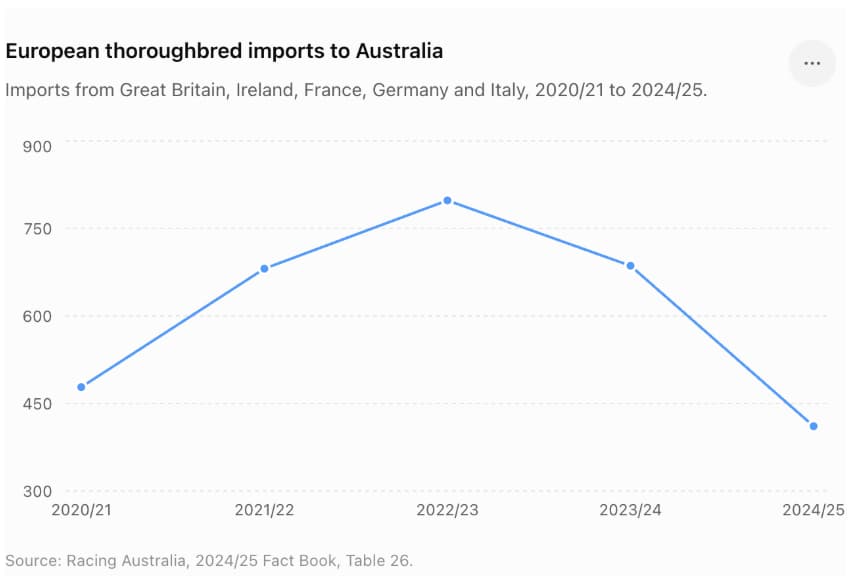
Australia’s extraordinary appetite for European bloodstock has cooled dramatically, with thoroughbred imports from the region almost halving in just two seasons.
But the decline in volume does not necessarily mean the appetite has disappeared. Instead, it may point towards a more selective market, where Australian buyers remain prepared to compete for the right horses but are less willing to deploy capital as widely as they were at the height of the boom.
To examine the trend, we went back through Racing Australia’s Australian Thoroughbred Imports data, using the latest historical series published in its 2024/25 Fact Book. We looked at imports from Great Britain, Ireland, France, Germany and Italy over the five seasons from 2020/21 to 2024/25.
The figures cover all thoroughbred imports rather than solely horses purchased as racing prospects, an important distinction, but it does provide a useful measure of how Australia’s demand for internationally sourced bloodstock has changed.
In 2020/21, Australia imported 478 thoroughbreds from the five European markets examined. That climbed to 681 in 2021/22 before reaching a peak of 798 in 2022/23.
A reversal followed. Imports fell to 686 in 2023/24 before dropping sharply to just 411 in 2024/25, a decline of approximately 48.5 per cent from the peak only two seasons earlier.
Of those 411 horses, 258 came from Great Britain, 104 from Ireland, 38 from France, eight from Germany and three from Italy.
On those numbers alone, it would be tempting to conclude Australia’s European buying boom has come to an abrupt halt. The broader picture, however, suggests something more nuanced.
Europe has not contracted in isolation. Total thoroughbred imports into Australia from all countries fell from 3,188 in 2022/23 to 2,801 in 2023/24 and then to 1,943 in 2024/25.
Imports from the five European markets examined have therefore fallen more sharply than total Australian thoroughbred imports over the same period. However, the comparison should be treated cautiously: the European figure represents a selected group of countries and the data covers all thoroughbred imports, not solely horses purchased as racing prospects.
What the figures do show is that the fall in European sourced horses has occurred alongside a significant contraction in imports more broadly.
Britain, Ireland and France remain important hunting grounds for Australian owners, trainers, syndicators and bloodstock agents searching for horses with established middle distance and staying form. Rather than buying an untried yearling and waiting several seasons to discover whether it possesses the required ability or stamina, buyers can target horses whose racing profiles are already established.
But getting those horses to Australia comes at a cost.
The purchase price is only the beginning. Transport, quarantine, veterinary requirements, GST and insurance all add to the investment, while Australian buyers are competing in an increasingly international marketplace for the most desirable prospects. Currency is another consideration: at current exchange rates, £1 is worth around A$1.91, meaning a £100,000 purchase equates to roughly A$191,000 before the additional costs of bringing that horse to Australia are factored in.
And, as Australian buyers competing in the United States have discovered, exchange rates are not the only factor that can influence purchasing power. President Donald Trump’s One Big Beautiful Bill Act restored permanent 100 per cent bonus depreciation for qualifying property acquired after January 19, 2025, with most qualifying horse purchases eligible. For eligible U.S. buyers, that can allow the purchase price to be deducted in the first year, providing a significant tax incentive that Australian buyers competing for the same horses do not enjoy.
In that environment, fewer imports do not necessarily equate to less demand for the best horses. The threshold for attracting Australian money may simply have risen.
There is also the broader economic environment to consider.
Racehorse ownership is discretionary spending and, for many smaller owners in particular, it sits firmly in the luxury category. When economic conditions tighten, that spending can be among the first to be reassessed. Serious buyers do not necessarily disappear, but the environment can influence where and how capital is spent.
That makes the import numbers worth considering alongside Australia’s economic performance over the same period.
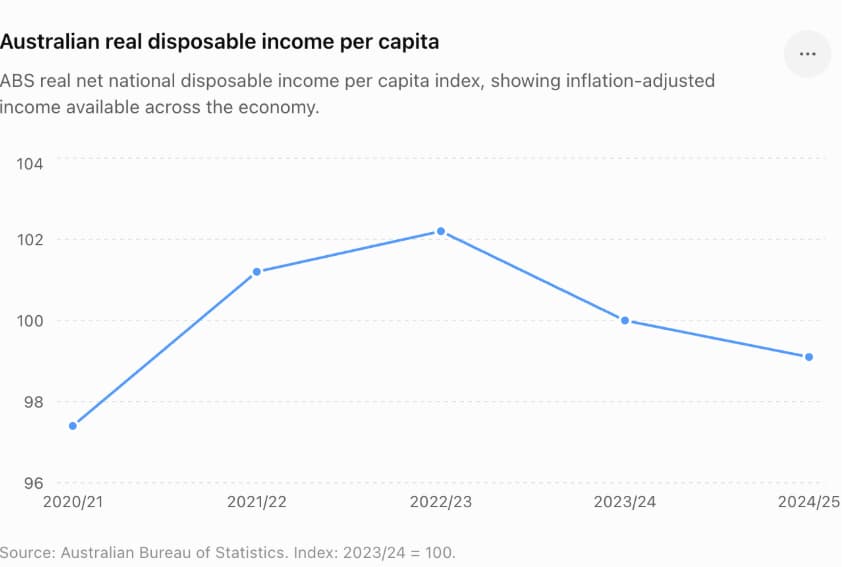
The broader economic backdrop also shifted over the same period, with Reserve Bank of Australia data showing real household disposable income per capita fell materially through 2022 and 2023 before beginning to recover from around mid 2024.
The timing does not establish a direct relationship between economic conditions and the decline in European imports, but it provides useful context. At the very least, the contraction in overseas buying has occurred against a markedly different economic backdrop. Which is of particular importance for horses that are purchased by syndicators who are breaking ownership down into much smaller bites.
It also raises a question for the domestic bloodstock market. If owners are spending less offshore, could some of that capital remain at home, potentially adding liquidity to the yearling, breeding stock or domestic tried horse and two-year-old markets?
There is no reason to assume a direct transfer. Some of the capital previously deployed internationally may simply not be being spent, while some may be concentrated among a smaller number of horses considered capable of delivering the required return.
The European summer has once again produced a fresh group of horses progressing through the ranks, giving Australian buyers plenty to assess. How aggressively they pursue them, however, can be difficult to gauge in real time.
Relatively few Australians participated in the European tried horse and two-year-old sales, while private transactions, an important avenue for sourcing horses, are difficult to track. The next import figures may therefore provide a clearer indication of whether numbers are beginning to stabilise or continuing on their current trajectory.
This week’s Caulfield Cup entries provide a timely reminder that, despite the decline in overall import numbers, European sourced horses remain firmly embedded at the top end of the Australian market.
Perhaps more revealing is the crossover in ownership. A relatively small group of prominent investors holds interests across multiple European-bred horses, often spread between different leading stables. Among the entries, interests associated with Aziz Kheir, J A O’Neill, Carty Racing, Greenhalghs and Sneesby Racing recur across multiple horses.
Ultimately, volume may no longer tell the whole story about Australia’s appetite for European bloodstock. In the current market, where Australian buyers spend, and the horses they are prepared to spend on, could prove more revealing than the headline number alone.
| Owner / ownership interest | European bred nominees | No. |
| Aziz Kheir (A Kheir) | Birdman, Buckaroo, Middle Earth, Saint George, Soulcombe, Sun God, Zahrann | 7 |
| J A O’Neill | Birdman, Buckaroo, Middle Earth, Saint George, Soulcombe, Sun God, Zahrann | 7 |
| Carty Racing | Birdman, Buckaroo, Middle Earth, Saint George, Soulcombe, Zahrann | 6 |
| Greenhalgh interests | Birdman, Middle Earth, Saint George, Soulcombe, Wootton Verni, Zahrann | 6 |
| Sneesby Racing | Birdman, Middle Earth, Royal Supremacy, Saint George, Soulcombe | 5 |
| A K Racing | Buckaroo, Saint George, Soulcombe, Sun God, Zahrann | 5 |
| Qatar Bloodstock | Buckaroo, Middle Earth, Saint George, Yellow Jersey | 4 |
| Deg Racing | Middle Earth, Saint George, Zahrann | 3 |
| Australian Bloodstock | Royal Supremacy, Vauban | 2 |
| Juddmonte | Jonquil, Purview | 2 |
| Sheikh Ahmed Al Maktoum | Almaqam, Sallaal | 2 |
| Go Bloodstock Australia | Sir Delius, Wootton Verni | 2 |
Source: Racing Australia, 2024/25 Racing Australia Fact Book, Table 26 — Australian Thoroughbred Imports by Country, 2020/21–2024/25.
https://publishingservices.racingaustralia.horse/Newsletters/2025_Racing_Australia_Fact_Book/52/