

A Numbers Game
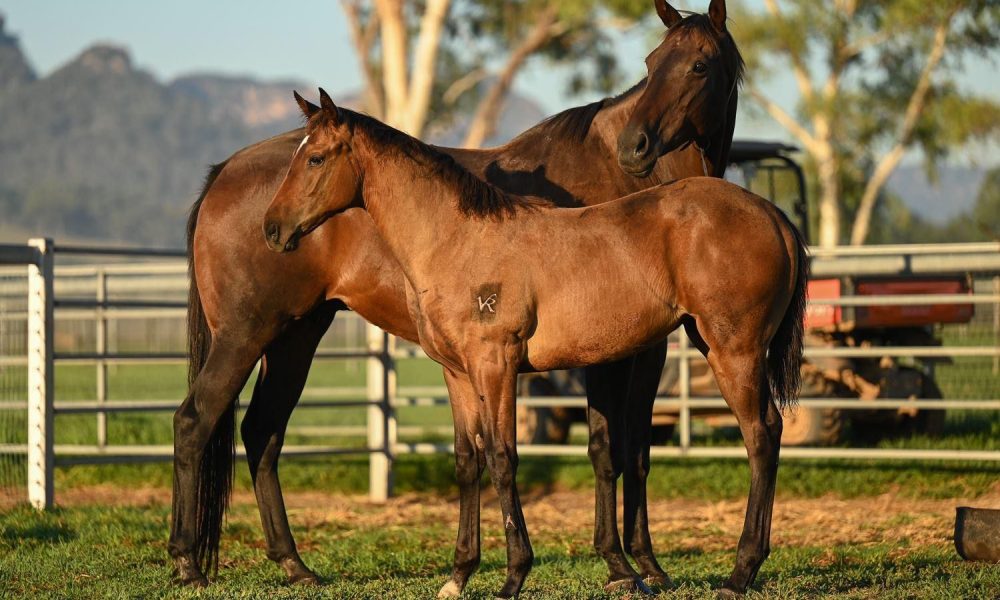
Image: Chilly Girl pictured as a weanling with her dam I Got Chills, (Credit: Supplied)
Chilly Girl (Trapeze Artist) may have been one of the youngest horses at Rosehill on Saturday, but as we touched on yesterday, the most interesting number on her pedigree page belonged to her mother.
The Rosebud Stakes (Listed, 1100m) winner is by Trapeze Artist (Snitzel) and out of I Got Chills, the former speedy General Nediym (Nediym) mare who won two Listed races before chipping a knee and training off. I Got Chills was foaled in 2003 and was around 20 when Chilly Girl arrived in October, 2023.
More strikingly, Chilly Girl was the last foal of a mare who had already enjoyed a long and productive career at stud. Racing and breeding records show I Got Chills had produced nine winners from nine runners before Chilly Girl came along; when the filly won the Group 3 Widden Stakes (Gr 3, 1100m) on debut in January, she became winner number ten and her dam’s first stakes winner.
There is something satisfying about the best arriving last.
It is also a useful catalyst for a question which confronts breeders at the start of every season and yearling buyers at every sale: how much should we care about the age of the dam?
The first thing to acknowledge is that age matters.
A 2020 Australian study of reproductive records from three major thoroughbred farms analysed more than 27,000 coverings involving 12,922 mares between 2000 and 2017. Although the study was principally examining inbreeding and reproductive outcomes, mare age was one of the variables considered and increasing age was associated with a significant decline in foaling success.
That won’t surprise any stud manager or reproductive veterinarian.
For the breeder deciding whether to cover a 14, 16 or 18-year-old mare, reproductive risk has to be overcome before market risk even enters the conversation. An older mare may take more cycles to get in foal, require greater veterinary management or be more likely not to produce a live foal at all.
Those are genuine costs and genuine risks for the breeder.
But the yearling buyer considering the dam’s age is standing at a very different point in the process.
By the time the produce of an older mare walks out of the box at Magic Millions, Karaka or Inglis, the mare has already got in foal, carried the pregnancy, delivered the foal and raised an individual that has survived and developed well enough to be catalogued for a commercial yearling sale.
Much of the reproductive risk associated with maternal age has already been carried by the breeder and overcome.
The buyer is not purchasing the prospect of getting an older mare pregnant, he or she is purchasing the horse standing in front of them, that may or may not, look like an old mares foal.
That raises another question: what actually constitutes an “old” mare in a modern Australian yearling catalogue?
A snapshot of some east coast 2026 catalogues is instructive, if not definitive.
A spot-check of exactly 100 yearlings, with 25 lots systematically spaced through each of the major east coast sales; Magic Millions Gold Coast Book 1, Inglis Classic, Inglis Premier and Inglis Australian Easter catalogues, produced a median maternal age of ten years at the time the yearling was foaled. The mean was almost identical at 9.95 years.
The individual sale medians were nine at the Gold Coast and ten at Classic, Premier and Easter. Nineteen of the 100 sampled yearlings, 19 per cent, were out of mares aged 13 or older.
The sample was deliberately spread through each catalogue rather than taken from a contiguous run of lots, and each sale contributed the same 25 horses. It should therefore be read as a four sale catalogue snapshot rather than a census, or as a catalogue size weighted estimate of the national yearling population. The four catalogues themselves ranged from 472 lots at Easter to 980 in Gold Coast Book 1.
Even with that qualification, the composition is instructive. A 13-year-old mare is older than the dam of the typical yearling in this sample, but 13-plus produce are hardly rare: roughly one yearling in five came from the older mare cohort.
That matters because anything outside the norm gives a potential buyer another reason to hesitate.
Weanling and yearling purchasing is often described in terms of selection and shortlists despite it often being more of a cull. An elimination rather than a selection process. The buyer is not selecting 20 horses from 980 for their shortlist, they are culling 960.
A yearling’s value can shift dramatically according to how many people happen to want it when it walks into the ring. A factor that causes one or two prospective purchasers to put a line through a horse before inspecting it seriously is not merely academic. It can be measured in bids.
Research into Australian yearling pricing is interesting. A study published in Applied Economics used data from ten auctions conducted by Australia’s two major auction houses, Inglis and Magic Millions, to examine the factors influencing yearling prices. It found that the racing records of parents and siblings were obviously important to valuation, alongside other factors such as maturity and sale level.
More interestingly for the older mare question, the population itself illustrates a problem with treating age in isolation.
The mares which remain in commercial breeding populations into their teens are not necessarily representative of the mares that began breeding years earlier.
A poor producer can disappear from a broodmare band at eight or nine. A mare who is stakes performed, beautifully bred, fertile, already a good producer or carrying an increasingly valuable family may be afforded opportunity after opportunity.
The older population has therefore been selected.
And that creates something of a paradox.
Biologically, the mare is ageing. Commercially and genetically, however, the mares allowed to grow old in good broodmare bands may be among the better members of the original population.
So when somebody asks whether an old mare is less likely to produce a good horse, there are really two questions. Does the ageing process reduce her reproductive efficiency? The Australian evidence says yes. And does reaching 13-years-old suddenly make the resultant foal standing in front of you at a yearling sale a lesser racing prospect? That assumption is much harder to support.
Chilly Girl is the latest to illustrate why.
I Got Chills did not reach her final foal with a production record littered with failures. She had been doing something breeders spend an enormous amount of money trying to achieve: producing racehorses.
Her first nine runners were all winners. Chilly Girl made it ten from ten and, finally, supplied the black type.
Whatever effect age was having on I Got Chills biologically, and excluding high expectations that follow high service fees paid, her own record was supplying another piece of evidence for anyone assessing her produce.
She could still produce a runner.
Perhaps, then, the most useful question to ask about an older mare is not simply; How old is she? Rather, what has she produced lately?
Have her last three foals raced? Have they won? Were they sound? Were they good sized horses? Has there been an obvious deterioration in her produce? Has she continued to get in foal regularly? Are there long barren periods? Are her foals still getting into catalogues?
Those questions tell us more about the particular mare than her age alone.
Australasian pedigrees provide plenty of reminders.
Triassic (Tights) was foaled in 1990 and produced So You Think (High Chaparral) in 2006, making her approximately 16 when one of the finest horses of the modern Australasian era arrived. So You Think became a ten-time Group 1 winner across Australia and Europe.
Eight Carat (Pieces Of Eight) offers an even better lesson. Foaled in 1975, she produced Octagonal (Zabeel) in 1992 at around 17. He became Australian Horse of the Year and another ten-time Group 1 winner. The following year, at around 18, she produced another Group 1 winner in Mouawad (Zabeel).
Those horses do not prove that mare age is irrelevant.
Pointing to Octagonal and concluding that mares do not age would be rather like pointing to a 60-year-old marathon runner and concluding that humans do not age.
What they demonstrate is something more useful.
Whilst the probability of a good horse may decline. It does not disappear.
And that distinction matters in bloodstock because buyers are not attempting to purchase the average horse. They are trying to identify the exception within their budget..
There is, incidentally, a reason we have used 12 as a rough dividing line for old and young in this discussion.
Australian tax rules (TR 93/26) include special valuation provisions for horses held as breeding stock and, under those rules and depending on the circumstances and method applied, an older breeding mare can ultimately be carried at a nominal value.
It is an accounting treatment rather than a judgment on the mare’s genetic or commercial worth, and there are different circumstances in which the rules apply, but it offers an interesting contrast.
On paper, the old girl may eventually be written down to almost nothing. The question for the breeder, and eventually the yearling buyer, is whether her ability to produce a racehorse has declined to anything like the same degree.
That is why, for the purposes of this discussion, mares aged 12 and younger may be usefully compared with those aged 13 and older.
But chronological age is still only one number. Foal number also deserves consideration.
A 15-year-old mare producing her fifth foal after entering stud late is not necessarily the same proposition as a 15-year-old producing her twelfth.
Nor are all matings equal.
A mare may begin her breeding career highly commercial and visit expensive proven stallions, then slide down the stallion ranks as her commercial appeal declines. If her later progeny prove inferior, some of what looks like an age effect may actually be a sire quality effect.
The reverse often occurs too. A mare establishes herself as a serious producer and earns access to better stallions as she gets older.
Previous progeny, foal order, fertility history, stallion quality, physical type and the mare’s own performance all interact with age.
That is why, in an ideal analysis would eventually compare thousands of Australian mares against themselves: their progeny produced at 12 and younger against their progeny produced at 13 and older, while adjusting for the stallions visited and the order of those foals.
The 24 hours since Chilly Girls victory hasn’t allowed for such research and data may not be detailed enough to put a clean percentage on that question which should make us cautious of arguments for and against age alone.
It would be wrong to say mare age does not matter simply because a Chilly Girl, a So You Think, a New Approach (Galileo) or an Octagonal existed.
It would be equally questionable to treat 13 years old as a “best before” date.
For a breeder, the thirteenth birthday might sensibly signal that the hurdle is getting higher. The mare’s reproductive history, recent foals and the economics of the mating deserve greater scrutiny.
For a buyer, however, much of that hurdle has already been jumped.
The foal exists. It has grown. It has been catalogued. And now it is standing in front of you.
At that point maternal age should sit alongside conformation, movement, sire, foal order, sibling performance and every other piece of information on the page — not necessarily above them.
Every market likes simple rules because simple rules are efficient.
First foal.
Young mare.
Proven mare.
Old mare.
But whenever a market turns a useful piece of information into an inflexible rule, there is the possibility that value is being left behind.
Chilly Girl arrived at the end of I Got Chills’ breeding career, not the beginning.
The old mare had already given breeders every reason to believe she could produce a racehorse. What she had not produced was one as good as herself, a curse many a good racemare will face.
Then came her last chance.
The numbers tell us there is reason to become more cautious as a mare grows older but they do not tell us to stop looking or stop breeding.
There may be less life in the old girl than there once was. But, as Chilly Girl has just reminded us, there can still be plenty.