

Magical mare shines a light on Japan’s sprinting division
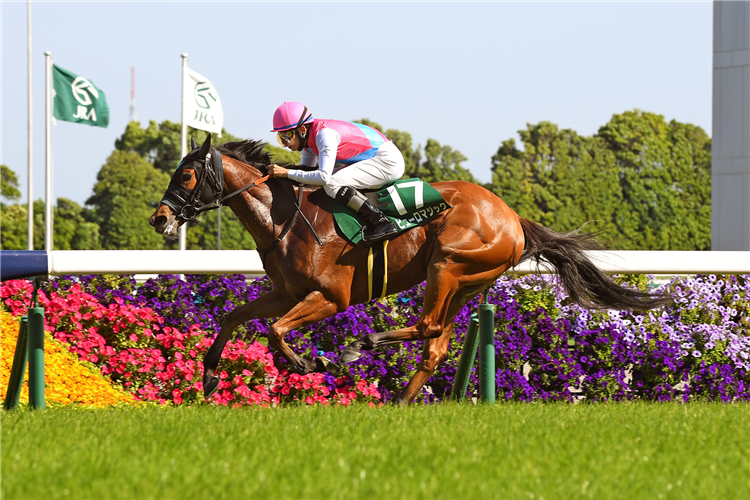
Image: Puro Magic (Credit: Japan Racing Association)
While Japan has traditionally been renowned for producing elite middle-distance and staying horses, the blistering performance of Puro Magic (Asia Express) over the weekend has perhaps put The Everest (Gr 1, 1200m) slot-holders on notice that her home nation’s sprinting ranks are ready to showcase their wares on the international stage.
Puro Magic stopped the clock at 53.50 seconds when claiming her fifth stakes success in Saturday’s Ibis Summer Dash (Gr 3, 1000m), in the process breaking a national 1000m record that had stood the test of time for 24 years.
For context, Black Caviar (Bel Esprit) holds the 1000 metre (straight track) record in Australia with a time of 55.42 seconds, set when winning her third Lightning Stakes (Gr 1, 1000m) at Flemington back in February 2013; while in New Zealand the 1000 metre benchmark was set by Ticklish (Maroof), who scorched the Riccarton Park turf in a time of 54.20 seconds in the 2006 Pegasus Stakes (Listed, 1000m).
Although she was assisted by a firm surface at Niigata – the same venue where the previous 1000 metre record holder Calstone Light O (Warning) recorded a time of 53.70 seconds in 2002 – Puro Magic is nonetheless clearly a freakishly fast mare. And with none of the local brigade seemingly able to match motors with Ka Ying Rising (Shamexpress), the current $1.50 Everest favourite, slotholders may therefore be tempted to cast their net wider this year.
Three of Puro Magic’s five black-type victories have come over 1200m, so she is by no means only a 1000 metre specialist. With the Japan Racing Association (JRA) recently approving The Everest – together with the Caulfield Cup (Gr 1, 2400m) and Melbourne Cup (Gr 1, 3200m) – for its domestic wagering markets on the condition that a Japanese-trained horse competes in the race, there is an added incentive for Racing NSW and the embattled Australian Turf Club to launch an international recruitment drive.
Her sire, Asia Express (Henny Hughes) was Crowned Champion 2-Year-Old Colt in Japan in 2013 and is out of the Running Stag (Cozzene) mare Running Bobcats, an American winner of five stakes races. Asia Express was undefeated in his first three starts including the prestigious Asahi Hai Futurity Stakes (Gr. 1, 1600m) on turf but also captured the Leopard Stakes (Gr. 3, 1800m) on dirt as a 3yo. As a stallion, Puro Magic is his best performer.
She is the only Stakes performer thus far amongst three winners from four runners for her dam Medjerda (Deep Impact). Merjerda was precocious, out of a French Deputy (Deputy Minister) mare Melusine, a stakes placed sprinter in the 2d Kyoto Sho Fantasy S (Gr.3, 1400m). Puro Magic’s half-brother by Saturnalia (Lord Kanaloa) was the top-priced colt, purchased by Jun Fukumoto for ¥80 million JPY, at last month’s Selection Sale whilst another half brother went through the 2026 JRHA JRA Select Yearling & Foal Sale for ¥57, million to the bid of Hajime Satomi.
The connections of Puro Magic are certainly prepared to travel, having sent the daughter of Asia Express (Henny Hughes) on two hit-and-run missions last year – albeit she was ultimately unable to make an impression on either occasion, finishing 10th in the Breeders’ Cup Turf Sprint (Gr 1, 1000m) in the United States and fifth in the Al Quoz Sprint (Gr 1, 1200m) in Dubai.
Most recently her compatriot Satono Reve (Lord Kanaloa), whose globetrotting sire secured back-to-back victories in the Hong Kong Sprint (Gr 1, 1200m), has come agonisingly close to topline international success courtesy of a pair of minor placings in the Queen Elizabeth II Jubilee Stakes (Gr 1, 1200m) at Royal Ascot and the July Cup Stakes (Gr 1, 1200m) at Newmarket.
One man who is very closely aligned with Japan’s revered racing and breeding industry is Kosi Kawakami, who has spent the past 25 years living and working in Australia, previously as a jumps jockey and trackwork rider before more recently establishing the successful Rising Sun Syndicate.
An accredited translator, Kawakami has also acted as an interpreter for several Japanese trainers travelling their horses to compete in Melbourne’s Spring Racing Carnival – most notably the connections of Lys Gracieux (Heart’s Cry) and Mer De Glace (Rulership), respectively the winners of the Cox Plate (Gr 1, 2040m) and the Caulfield Cup in 2019.
Kawakami has just returned from a working holiday in Japan, where he caught up with the connections of stakes-winning stayer Stinger Glass (Kizuna) who – provided he passes all the necessary veterinary protocols – is likely to touch down in Melbourne in mid-October to prepare for his tilt at the Melbourne Cup.
Stinger Glass is by two-time Japanese champion sire Kizuna (Deep Impact) out of dual Argentinian Group 1 winner Life For Sale (Not For Sale). He is a half-brother to Japan’s champion two-year-old filly Danon Fantasy (Deep Impact)
Unlike in Australia, where the need for speed is seemingly all-consuming, at least for the foreseeable future Japanese owners and breeders will continue to prioritise the pursuit of premium middle-distance gallopers and stayers over sprinters. However, Kawakami readily concedes that the lure of a $20 million prize pot is certainly a strong selling point.
“The Melbourne Cup is definitely still the most well-known Australian race in Japan, but The Everest is growing in popularity over there,” Kawakami told ANZ News.
“We had some inquiries about The Everest from a few owners and trainers when I was over in Japan, and while I can’t mention any names there was definitely some interest in sending their horses over for the race. I don’t think it will happen this year, especially with Ka Ying Rising in the race, but I wouldn’t be surprised if Japan had a runner in The Everest in the future.
“Of course, money talks, but the main problem is that Australian sprinters are among the best in the world. So even though the prize-money is amazing, there is no point sending a horse just to run midfield. Japan’s sprinters are still nowhere near as strong as our middle-distance horses, but maybe the gap is closing a little and Satono Reve showed that our best are good enough to be competitive on the world stage. You need a very good horse to win an Everest and although Puro Magic won really well at the weekend, it’s probably still a big ask to come to Australia and beat the local sprinters.
“But you never say never, and the fact that it’s now a Group 1 makes it much more appealing for Japanese owners and trainers to target the race. The breeding industry is obviously huge in Japan, the main aim is to produce stallions and with the fact that the Golden Eagle is also a Group 1 race, I think you will also see more and more people targeting that race from now on.”
As for the prospects of Stinger Glass becoming the second Japanese horse to capture Australia’s most famous race, Kawakami believes that the five-year-old entire is a more polished product than Warp Speed (Drefong), who finished second behind Knight’s Choice (Extreme Choice) in the Melbourne Cup two years ago.
“I spoke to the trainer [Yasuo Tomomichi] when I was in Japan and he’s very excited to bring the horse over here for the Melbourne Cup,” Kawakami told ANZ News.
“He’s a good horse, and he should be well handicapped so he probably won’t have to carry too much weight. I think he’s a better horse than Warp Speed, with much better form lines. Warp Speed was only stakes placed whereas Stinger Glass has won at Group level [in the G3 Diamond Stakes over 3400m], so we know he will stay the trip. I think they will use a local rider, so I assume Damian Lane will be given the first option.
“It helps that the Caulfield and Melbourne Cups fit in well with the program, because there are no Group 1 staying races in Japan at that time of year. There’s the Tenno Sho in April or May but nothing in October or November, so if you have a good stayer then why wouldn’t you think about sending them over for the Cups?
“The biggest problem they face is the cost, because it is very expensive to fly horses to Australia and there aren’t that many flights you can get them on. They also have to spend a long time in quarantine, so there are challenges and it’s not an easy decision to make. But at least with the increase in Melbourne Cup prize-money to $10 million, every runner gets a paycheque so that covers some of the costs.”
Stinger Glass will begin his mandatory two-week pre-export quarantine in the salubrious surrounds of Northern Farm next month before boarding his flight to Melbourne.
In the more immediate future his shuttling compatriots Maurice (Screen Hero) and Panthalassa (Lord Kanaloa) will be recommencing their stud duties in Australia. Once Marice has completed quarantine next week, the former will be diverted to the familiar environs of Arrowfield Stud in the Hunter Valley, where he will stand alongside his son Hitotsu (Maurice); while Panthalassa returns for a third stint at Yulong’s Nagambie farm, having covered multiple high-class mares, including Group 1 heroine Montefilia (Kermadec) on his first foray to these shores.
There are strong Japanese bloodlines running through the roster at Yulong, with Tagaloa ($22,000) and Diatonic ($13,750) both sons of sprinting sensation Lord Kanaloa (King Kamehameha)